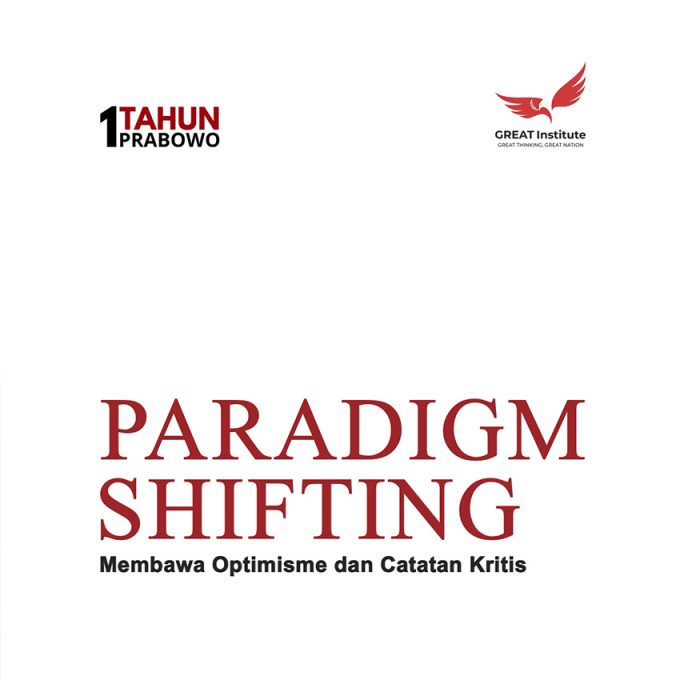



This book is divided into two major sections: eight achievements of the administration and eight critical assessments, followed by an epilogue. The following summary preserves the main focus, arguments, and evaluations presented in the manuscript.

The central argument of the GREAT Institute’s book is that expanding the state’s presence is a starting point, not definitive proof of development success. Government performance must be assessed by its ability to translate budgets, programs, and authority into tangible, measurable benefits for society while maintaining accountability, productivity, and the quality of democracy.
Part I — Achievements of the Prabowo Administration
Chapter 1. Expanding the Reach of the Welfare State
The Prabowo administration has expanded the state’s presence through the Free Nutritious Meals (Makan Bergizi Gratis, or MBG) program, Free Health Check-ups (Cek Kesehatan Gratis, or CKG), and Sekolah Rakyat (People’s Schools). These three initiatives strengthen the provision of basic services and directly reach communities through nationwide service networks.
This expansion represents an important institutional achievement, but it does not automatically demonstrate long-term improvements in public welfare. Service quality, beneficiary targeting, food safety, budget sustainability, and protection for older adults and informal workers remain areas requiring attention.
Chapter 2. Strengthening Economic Growth
Indonesia’s economy has maintained growth of approximately five percent and showed stronger performance in the first half of 2026. Household consumption, investment, and the increasing contribution of government consumption have been important components supporting national economic activity.
However, this growth must be assessed in terms of its quality and underlying drivers, rather than aggregate figures alone. The next challenge is to strengthen productivity, expand access to quality employment, and ensure that economic growth generates more equitable increases in household incomes.
Chapter 3. Poverty Reduction and the Dynamics of Inequality
The data presented in the book indicate that the poverty rate declined from 8.57 percent in September 2024 to 8.07 percent in March 2026. The number of people living in poverty also decreased, while expenditure inequality declined compared with the beginning of the administration’s term.
Nevertheless, improvements in national indicators have not eliminated the vulnerability of poor households, particularly to rising food prices. Inequality increased again in March 2026 compared with September 2025, underscoring the continued importance of income generation, accurate targeting of assistance, and the affordability of basic necessities.
Chapter 4. Accelerating the Energy Transition Agenda
The government is promoting energy security by strengthening domestic supply, expanding the use of biodiesel, and developing renewable energy. These initiatives aim to reduce dependence on foreign supplies while supporting economic transformation and environmental sustainability.
The success of the energy transition cannot be measured solely by the number of programs introduced or increases in production capacity. Evaluation must also consider realized investment, the energy mix, affordability, environmental impacts, and the ability to sustainably reduce dependence on fossil fuels.
Chapter 5. Protecting Workers and Expanding Economic Access
The government is strengthening worker protection and expanding economic access through labor policies, agrarian reform, and the development of Merah Putih Village and Urban Ward Cooperatives (Koperasi Desa dan Kelurahan Merah Putih). These policies seek to connect social protection with productive economic opportunities for communities.
The main challenge is to ensure that these policies deliver tangible benefits rather than merely establishing institutions or distributing programs. Job quality, income security, access to productive assets, protection for informal workers, and the economic benefits generated by cooperatives should serve as key evaluation criteria.
Chapter 6. Anti-Corruption Efforts and the Recovery of Public Resources
The anti-corruption agenda is positioned as an instrument for recovering public resources and strengthening accountability in the management of state wealth. Law enforcement and asset recovery have the potential to expand the government’s capacity to finance development and meet public needs.
However, success must be distinguished across the different stages of investigation, enforcement action, judicial rulings, and assets actually recovered by the state. Procedural transparency, legal certainty, institutional accountability, and the use of recovered assets are essential to demonstrating the benefits of anti-corruption policies.
Chapter 7. Managing State Wealth for Public Prosperity
State ownership and the management of public wealth are viewed as efforts to strengthen economic sovereignty and ensure that strategic resources deliver greater benefits to society. The state is expected to connect asset management with development financing and the equitable distribution of prosperity.
The principal challenges concern governance, transparency, the effectiveness of asset utilization, and the distribution of returns. A commitment to the public interest must be demonstrated through measurable benefits, strong oversight, and institutional accountability that can be scrutinized by the public.
Chapter 8. Democracy and the Fulfillment of Human Rights
Democracy and human rights are essential dimensions in assessing government accountability. The discussion encompasses access to justice, freedom of expression, the protection of cultural rights, and the protection of Indonesian citizens abroad.
Democratic progress depends not only on formal policies but also on law enforcement and the protection of rights in practice. Public participation, freedom of expression, remedies for victims, and oversight mechanisms remain necessary to ensure that power is exercised responsibly.
Part II — Critical Assessments of the Prabowo Administration
Chapter 9. Governance and the Implementation of Priority Programs
The expansion of priority programs, including MBG, Sekolah Rakyat, CKG, and Merah Putih Village and Urban Ward Cooperatives, demonstrates an increased role for the state. However, accelerated implementation creates challenges involving institutional coordination, human resource readiness, budget oversight, and accurate beneficiary targeting.
Program evaluation must shift from measuring outputs to assessing outcomes that people actually experience. Food safety, procurement transparency, complaint mechanisms, implementation accountability, and impact measurement must be strengthened to ensure that expanded programs deliver high-quality and sustainable services.
Chapter 10. Premature Deindustrialization and the Narrowing Path to the Middle Class
The declining role of manufacturing in the economic structure limits Indonesia’s ability to create productive employment on a broad scale. Economic growth and investment have not fully restored industrial employment absorption, placing structural pressure on people’s opportunities to enter the middle class.
Revitalizing manufacturing requires technology, access to competitively priced raw materials, workforce skills, and certainty in export markets. Downstream industrialization must also build stronger domestic industrial linkages so that value-added growth generates quality jobs, higher real wages, and more widely distributed economic benefits.
Chapter 11. Suboptimal Business and Labor Productivity
Business and labor productivity remain obstacles to improving Indonesia’s economic competitiveness. Uncertain production costs, licensing barriers, technological constraints, and skills mismatches limit companies’ ability to improve efficiency and generate added value.
The government needs to strengthen licensing reform, technology adoption, and alignment between education and industrial needs. Productivity improvements must be accompanied by job creation, real wage growth, and worker protection to ensure that the benefits of efficiency do not accrue solely to capital-intensive companies.
Chapter 12. Dismantling Structural Barriers to Achieve 8 Percent Growth
Achieving the target of eight percent economic growth by 2029 requires a strategy that goes beyond the prevailing growth pattern of approximately five percent. Repeated fiscal stimulus and purchasing-power assistance alone are insufficient to bring about fundamental changes in national productive capacity.
Transformation requires structural reform, simplified licensing procedures, stronger industrialization, quality job creation, and the development of new sources of growth. Short-term policies must be accompanied by improvements in investment productivity, economic diversification, and the removal of barriers that constrain business expansion.
Chapter 13. Global Geopolitics and Indonesia’s Vulnerability as a Net Importer of Oil and Gas
Global geopolitical tensions, particularly conflicts in the Middle East, increase the risk of oil price volatility and energy supply disruptions. As a net importer of oil and gas, Indonesia faces pressure on its trade balance, energy subsidies, and the government’s fiscal space.
Energy security requires diversified supplies, stronger domestic production, greater consumption efficiency, and an accelerated energy transition. The government must also balance energy price stability with fiscal sustainability to prevent external shocks from reducing funding for social protection and development.
Chapter 14. The Risk of AI-Driven Disinformation Amplification and Polarization
Advances in artificial intelligence are increasing the capacity to produce and distribute manipulative content, including information that may exacerbate political polarization. The speed at which digital content spreads makes verification more difficult, increases the risk of opinion manipulation, and undermines public trust in information.
Addressing these risks requires digital literacy, information verification, platform transparency, and responsive public communication capabilities. Anti-disinformation policies must also safeguard freedom of expression to ensure that efforts to protect the public do not become instruments for suppressing criticism or abusing authority.
Chapter 15. Electoral System Reform and Political Stability
Electoral system reform faces the challenge of balancing government effectiveness, political representation, and public trust. The book highlights approximately 17.3 million valid votes in the 2024 election cast for political parties that failed to meet the parliamentary threshold.
Electoral reform must consider proportional representation, party accountability, and the legitimacy of democratic institutions. Sustainable political stability cannot be built solely on government effectiveness; it also requires opportunities for participation, fair political competition, and protection of citizens’ political rights.
Chapter 16. Disaster Management
Floods, landslides, volcanic eruptions, and forest and land fires test the state’s capacity to protect communities from threats to their lives and livelihoods. Disasters can eliminate income, disrupt education, and increase the vulnerability of poor households.
The success of disaster management cannot be measured solely by the speed of emergency assistance. Preparedness, risk mitigation, interagency coordination, early warning systems, and community economic recovery must be strengthened to reduce long-term losses and prevent recurring poverty.
Part III — Epilogue
Chapter 17. Continuing the Transformation Toward Prosperity
The first two years of the Prabowo administration have established a foundation through expanded basic services, a strengthened economic agenda, worker protection, and the management of public resources. These achievements reflect a policy direction in which the state plays a more active role in meeting public needs.
The next phase requires improvements in implementation, transparency, oversight, and outcome-based evaluation. The transformation toward prosperity will become more meaningful when services are of high quality, economic opportunities expand, and state institutions can be held accountable for the benefits of development delivered to society.