

By Adrian Nalendra Perwira – Economist, GREAT Institute
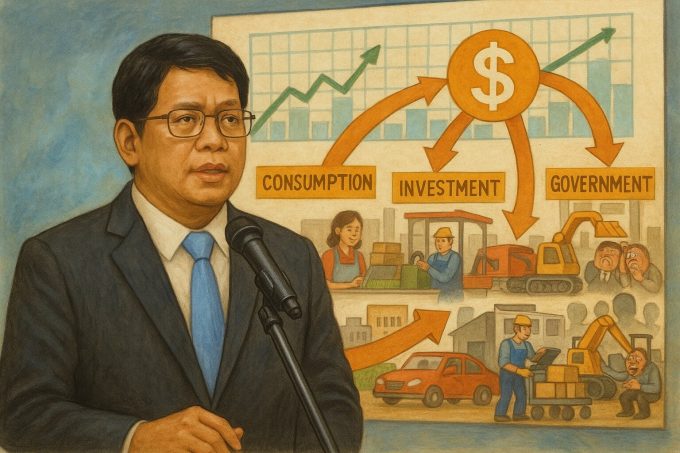
In various public forums, President Prabowo has expressed an aspirational target of 8 percent economic growth by 2029. Since Purbaya Yudhi Sadewa was appointed Minister of Finance of the Republic of Indonesia, this aspiration has resurfaced. In his lecture at a public seminar organized by the GREAT Institute, he stated that this ambition is not impossible; in fact, it is necessary if Indonesia is to escape the middle-income trap.
To achieve this vision, an unprecedented wave of investment is required. The National Medium-Term Development Plan (RPJMN) has outlined the figure: approximately IDR 47,573 trillion for 2025–2029, equivalent to IDR 47.6 quadrillion or around US$3 trillion.
Of this enormous amount, the private sector accounts for 86.65 percent, the government around 7.22 percent, and state-owned enterprises 6.13 percent. This means the key to financing does not lie in the capacity of the state budget (APBN), but in our ability to make projects in Indonesia commercially viable so that large-scale private capital is willing to enter at a reasonable cost.
However, attracting capital alone is not enough; it must be productive. Here, investment efficiency becomes decisive, reflected in the incremental capital output ratio (ICOR). If ICOR remains high, growth driven by large spending will only inflate costs. With an ICOR of around 6.33 in 2023, this means that for every additional $1 of GDP, more than $6 of additional investment is required.
A study by Thawley et al. (2024) estimates that with an ICOR of around 6.6 and an investment contribution below 30 percent of GDP, economic growth reaches only about 5 percent. However, if ICOR can return to its historical level of 4.5 (the 1987–1992 record), growth of 7.5 percent can be achieved without increasing the investment share. If ICOR remains high, investment must increase by about 1.5 times to reach 7.5 percent growth. This confirms that strategy must move on two tracks: reducing ICOR while simultaneously attracting more investment.
Legal Certainty is Oxygen for Investment
Before committing billions of dollars, investors do not only look at market potential. Their first question is: “Is my investment safe? Are the rules clear and fair?” Here, the role of the National Police (Polri) as the frontline of law enforcement becomes crucial.
Imagine an investor building a factory in a region. They will face various risks: land disputes, illegal levies (pungli), and extortion by unscrupulous actors. If local police are unprofessional, unresponsive, or selective in enforcement, the “transaction costs” of doing business become high and unpredictable. These unseen risks are often more frightening than tax rates themselves.
A study by Bénassy-Quéré et al. (2007) shows that public sector efficiency is a key determinant of foreign direct investment (FDI). This efficiency includes low corruption, contract enforcement, protection of property rights, and effective justice. From this perspective, a professional police institution is not merely complementary but a backbone of public sector efficiency.
The Path of Police Reform
On 17 September 2025, the Chief of Police signed a directive establishing a Police Reform Transformation Team consisting of 52 senior officers to evaluate and accelerate internal reform. At the same time, the government is preparing a presidential commission on police reform. The window is open; the question is: what problems must be solved so that this “oxygen” of legal certainty truly becomes available?
The answer lies in data showing the fragility of legal certainty in Indonesia. First, Indonesia’s rule of law quality is not yet convincing for investors. In the World Justice Project (WJP) Rule of Law Index 2024, Indonesia ranks 68th out of 142 countries. Its scores for “absence of corruption” and “criminal justice system” remain low—clear warning signals for investors.
Second, corruption in police services remains high. Transparency International (2020) reported that 41 percent of police service users in Indonesia had paid bribes, nearly double the regional average. These are hidden transaction costs that silently increase project ICOR.
Third, from the business perspective, security risks are often more concerning than tax rates. The World Bank Enterprise Survey 2023 shows that 15 percent of firms in Indonesia identify crime, theft, and disorder as major constraints, while only 6 percent cite tax rates.
Fourth, law enforcement inefficiency directly reduces state revenue. A clear example is illegal cigarette circulation, which causes an estimated state loss of IDR 97.81 trillion annually in excise revenue (Indodata Research Center, 2024). With 95.44 percent of violations involving unstamped products, this is no longer just border smuggling but a large-scale domestic illegal industry requiring strong police involvement alongside customs enforcement.
In the 2026 draft state budget (RAPBN), police funding is set at IDR 145.65 trillion (up 5.12 percent), making it the third-largest allocation among ministries and institutions. This creates a paradox: why does such a large budget not translate into proportional improvements in professionalism and public trust? The issue is no longer funding, but spending quality, allocation priorities, and accountability mechanisms.
From an economic perspective, police reform is about treating its budget as an investment in the state’s most critical intangible asset: trust and legal certainty. Reform must focus on improving return on investment of this budget. Civil society groups such as KontraS, YLBHI, and Imparsial have long advocated comprehensive reform: independent civilian oversight, improved governance and accountability, and recalibration of authority in line with the rule of law.
Ultimately, police reform is a true test of the government’s commitment to building a world-class investment climate. Without courage to invest in this institutional foundation, the 8 percent growth target will be constrained by the invisible costs of uncertainty and mistrust.