

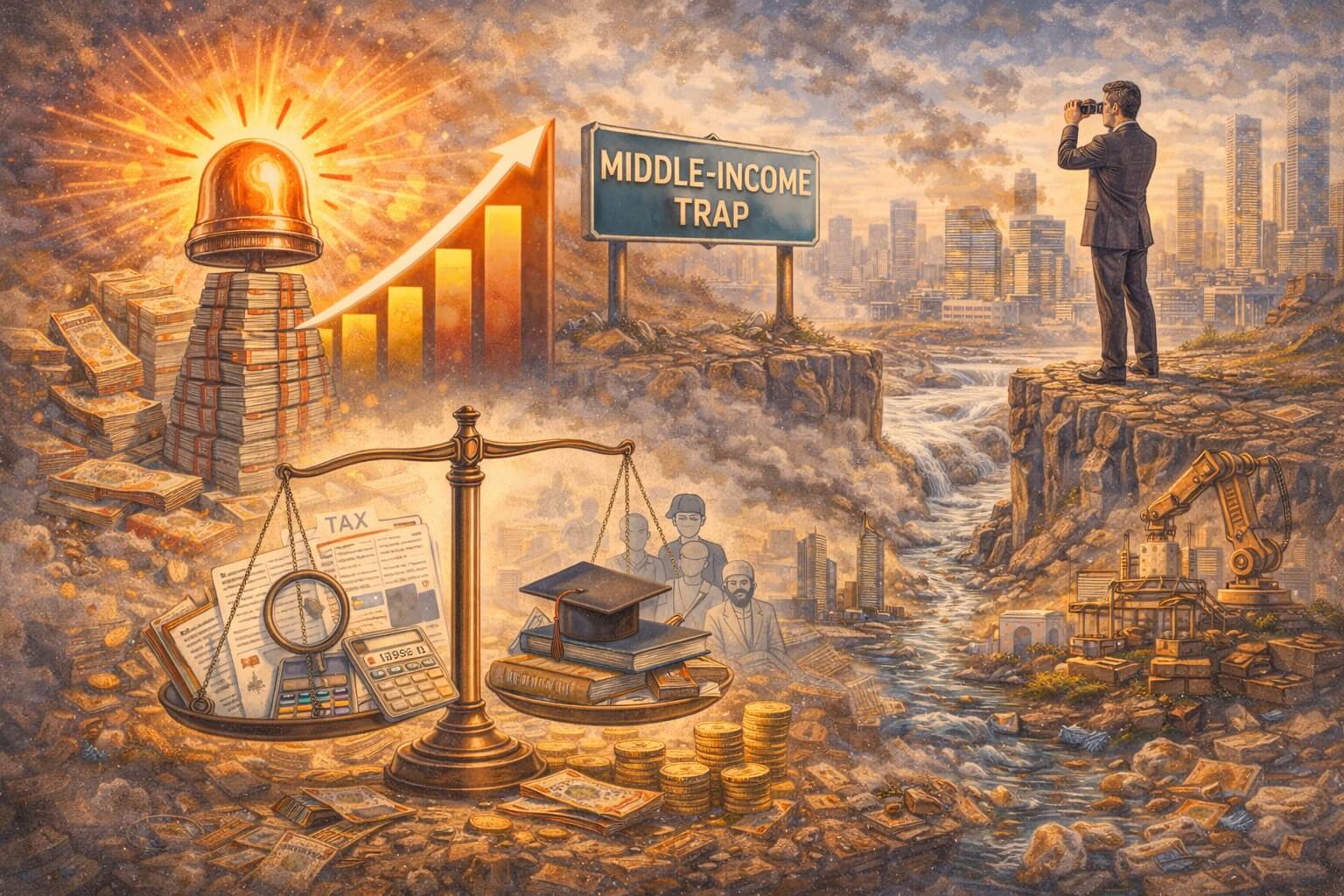

By: Perdana Wahyu Santosa* JERNIH.co– Recent economic data presents a (slightly) less romantic but highly realistic message: Indonesia aims to immediately “sprint” and escape the middle-income trap, yet our “fiscal muscle” remains relatively small. This is not merely a technocratic debate about numbers; it is a matter of the state’s capacity to finance a leap in productivity.
Middle-Income Trap: Not a Curse, But a Delayed Graduation
The World Bank emphasizes that many middle-income countries stop moving up the ladder: since 1970, the per capita income of the “median” middle-income country has never exceeded 10% of the US level; and only a small fraction has successfully transitioned to high-income status since the 1990s.
Why the stagnation? Because the transition from “growing through cheap labor and basic investment” to “growing through innovation, institutional quality, and high productivity” demands well-targeted and consistent public spending. In more down-to-earth terms: toll roads alone are not enough; you need competent schools, vibrant research, healthcare services that keep workers productive, a bureaucracy that does not hinder, and social protection that prevents shocks from plunging households into poverty.
At this juncture, economic data estimates (World Bank) serve as a sort of X-ray: Indonesia’s tax ratio has hovered around ~10% of GDP (2000–2024) and government spending around ~15% of GDP, whereas examples of countries that escaped the trap (South Korea, Chile) demonstrate a more “spacious” fiscal room during crucial phases of development. The core point is simple: countries aiming to move up the ladder usually possess the fiscal capacity to pay for the cost of graduation.
Issues of Base, Compliance, and Quality of Spending
The greatest temptation is to oversimplify the diagnosis, where the easiest solution is “just raise taxes.” That assumption has very short legs. Instead, what typically occurs is a combination of three factors:
- First, a narrow tax base—not just because of rates, but due to economic structure (informality), exemptions, accumulated incentives, and the tax gap (potential revenue lost due to compliance and design). Without debating definitions, simply compare it to Korea’s “fiscal stamina”: the OECD notes that Korea’s tax-to-GDP ratio rose from 20.9% (2000) to 28.9% (2023). This provided room for state investment in human capital, technology, and institutions.
- Second, administration and compliance. Healthy revenue growth rarely comes from “raising rates”; it usually comes from widening the net—integrated data, fair enforcement, simplified processes, and legal certainty. Countries that successfully escape the trap tend to strengthen their ability to convert growth into revenue—without killing the productive sector.
- Third, the quality of spending. Even if revenue increases, without effective spending, the result is merely a “larger state budget” rather than a “more productive economy.” The World Bank WDR 2024 emphasizes a phased strategy—investment, infusion, innovation—which essentially forces the state to restructure spending priorities so that productivity actually rises.
Strategic Recommendations
If the target is to seriously escape the trap, the recipe should be two-sided: increasing fiscal space and transforming the quality of expenditures. This is a more realistic package with fewer illusions:
(a) Revenue reform based on “expansion,” not “extortion.” Focus on closing VAT loopholes (rationalization of exemptions), strengthening specific consumption taxes (pro-health and pro-productivity excises), and stronger property taxes at the regional level—as these are relatively growth-friendly compared to burdening productive investment.
(b) A “fiscal contract” that drives public compliance. Compliance increases if citizens and the business world see their money return as tangible public services: vocational education linked to industry, healthcare services that reduce lost working hours, and infrastructure that cuts logistics costs.
(c) Forcing state spending to become a productivity engine. Moving up the ladder requires spending that triggers human capital and innovation: teacher quality, applied research, value-added industrial ecosystems, digitization of public services, and social protection that prevents households from fluctuating during shocks.
(d) Disciplined program evaluation: halt spending that lacks measurable outcomes. Advanced countries are not countries with “many programs,” but countries that dare to terminate non-impactful programs.
(e) Central–regional synchronization. If taxes and public services are “disconnected,” the result is fragmentation: revenue is difficult to raise, spending lacks focus, and investors face expensive coordination costs.
(f) A sane industrial policy narrative. Not emotional protectionism, but an upgrading strategy: promote value-added exports, strengthen supply chains, and improve the competitive climate. Literature on the middle-income trap also emphasizes structural transformation—shifting from low-productivity to high-productivity activities—as the key to escaping the trap.
Conclusion
From Bappenas data, this can be interpreted as an “alarm.” However, that alarm does not mean “taxes must be raised.” The alarm means Indonesia needs to expand its fiscal capacity through base broadening and compliance, while forcing spending to become a more productive engine. Escaping the middle-income trap is not a matter of big dreams for Indonesia; it is simply a matter of a state budget that is strong enough and smart enough to pay the cost of graduation.
*Economics Professor, Dean of FEB YARSI University, and Research Director of GREAT Institute