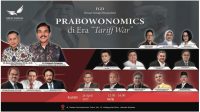



The Deputy Speaker of the House of Representatives of the Republic of Indonesia (DPR RI), Sufmi Dasco Ahmad, visited the Indonesia Stock Exchange together with the leadership of the Daya Anagata Nusantara Investment Management Agency, namely Rosan Roeslani as CEO of Danantara and Dony Oskaria as COO of Danantara on Tuesday, May 19, 2026. Their arrival was welcomed by Friderica Widyasari Dewi and the board of directors of the Indonesia Stock Exchange (IDX).
During the visit to the IDX, the discussion highlighted several concrete measures to attract and reassure global investors to continue entering the market, while also maintaining the confidence and growth of local retail investors. This step is considered substantial in facing pressure on the Composite Stock Price Index (IHSG) and the weakening of the rupiah exchange rate. The presence of state officials and the leadership of Danantara at the IDX building serves as a signal of support for Indonesia’s capital market.
GREAT Institute views this visit as a signal of state presence and strengthened institutional coordination amid market pressure. This assessment also dismisses the uproar claiming that the weakening of the Composite Stock Price Index (IHSG) was caused by the visit. The visit began at around 10:27 AM WIB, while pressure on the stock market had already been visible since the opening of morning trading. The IHSG opened at around 6,599, briefly fell to around 6,565 in the early minutes, before slightly rebounding into positive territory. At the close of trading, the IHSG ended at 6,370, down 3.46 percent from the previous day.
Economic researcher at GREAT Institute, Ani Asriyah, emphasized that linking the weakening of the IHSG to the arrival of Sufmi Dasco Ahmad is both temporally and analytically inaccurate. “The market was already under pressure even before the delegation arrived at the IDX building. Therefore, it is not appropriate to associate today’s IHSG weakening with Mr. Dasco’s visit. On the contrary, it could actually be said that the purpose of Mr. Dasco’s delegation’s arrival was to maintain confidence in the stock exchange,” said Ani.
According to GREAT Institute, there are at least three main factors currently pressuring the Indonesian stock market. First, the impact of the MSCI rebalancing announced last week. MSCI removed six Indonesian issuers from the global standard index and 13 issuers from the small-cap index due to high ownership concentration and transparency issues. FTSE Russell then took a similar step by announcing the removal of Indonesian stocks with high ownership concentration, while still postponing the full index re-ranking and the addition of new Indonesian stocks at least until September 2026. Meanwhile, Ani also stated that macroeconomic indicators are currently weakening. “We all know that the rupiah is depreciating and broke a new psychological level at Rp17,700 per US dollar in trading on May 19, 2026.
In addition, today, the issue regarding a single export gateway policy from the Ministry of Energy and Mineral Resources (ESDM Ministry) added negative sentiment to Indonesia’s capital market,” Ani added.
Ani believes that in a situation like this, the presence of Sufmi Dasco Ahmad together with Danantara should actually be appreciated because it shows that the state is not allowing the market to move on its own. “The presence of the DPR leadership, OJK, and Danantara at the IDX sends a message that the government and authorities are not ignoring market pressure. In times like these, symbolic presence remains important because markets are driven not only by data, but also by perceptions of coordination, leadership, and institutional seriousness,” said Ani.
GREAT Institute also noted that Sufmi Dasco Ahmad’s statement after the visit reflected a constructive direction. Sufmi Dasco Ahmad expressed confidence that Indonesia’s stock exchange would become stronger in the future, referring to the growth of retail investors, solid fundamentals, and efforts to improve regulations so that domestic investors feel more comfortable.
For GREAT Institute, messages like this are important to maintain confidence when the market is being shaken by short-term sentiment. In GREAT Institute’s view, the future policy agenda must move on two layers. In the short term, authorities need to actively maintain market and exchange rate stability so that risk-off pressure does not develop into a more costly confidence spiral. In the medium term, the government, OJK, and IDX need to accelerate reforms that have already begun following warnings from MSCI and FTSE Russell, including improving ownership transparency, adjusting free float regulations, and strengthening market credibility so that Indonesia is not continuously perceived as a market with high investability risk. OJK itself is targeting around three-quarters of issuers to comply with the 15 percent free float requirement in the first year of implementation.
This article has been published on VIVA.co.id