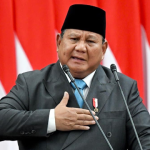

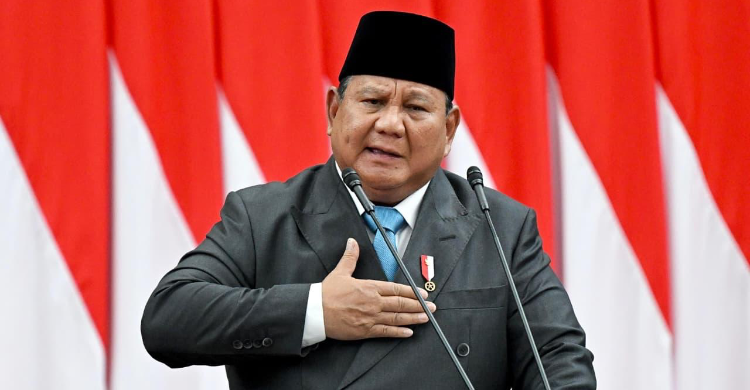

GREAT Institute appreciated President Prabowo Subianto’s speech during the Plenary Session of the House of Representatives of the Republic of Indonesia (DPR RI) on Wednesday, May 20, in which, for the first time, the President personally delivered the introduction to the Macroeconomic Framework and Main Fiscal Policy Directions (KEM-PPKF) for the 2027 State Budget Draft (RAPBN 2027).
Executive Director of GREAT Institute, Sudarto, assessed that this move marked a new milestone in Indonesia’s constitutional tradition, as the introduction to the KEM-PPKF had previously generally been delivered by the Minister of Finance.
According to Sudarto, the President’s direct presence at the DPR demonstrated that the government intends to position the 2027 State Budget as a strategic instrument to strengthen fiscal foundations and reorganize the direction of the national economic system amid global geopolitical and geo-economic uncertainty.
“The President did not present the State Budget merely as a state financial document, but as an instrument of national struggle,” Sudarto said in his statement on Wednesday, May 20.
In his speech, the President targeted economic growth for 2027 in the range of 5.8–6.5 percent, state revenue at 11.82–12.40 percent of gross domestic product (GDP), state expenditure at 13.62–14.80 percent of GDP, and a budget deficit maintained within 1.80–2.40 percent of GDP.
GREAT Institute considers the speech to carry greater weight than merely presenting annual macroeconomic targets. According to Sudarto, the President explicitly connected the State Budget with the agenda of protecting the people, reforming the structure of state revenue, and strengthening sovereignty over national wealth.
In his speech, the President also highlighted the low ratio of state revenue to GDP and the alleged leakage in the management of national wealth, including practices such as under-invoicing and transfer pricing.
“He also provided a diagnosis that Indonesia’s fiscal space is too narrow for a country of Indonesia’s size, and that this weakness cannot be separated from issues such as leakage, under-invoicing, transfer pricing, and weak state control over the value chains of strategic commodities,” said Sudarto.
In addition, the President reaffirmed the importance of returning to the mandate of Article 33 of the 1945 Constitution by ensuring that land, water, and natural resources are managed for the greatest prosperity of the people.
GREAT Institute believes this emphasis shows that the government is beginning to combine the macro-fiscal agenda with corrections to the national economic structure more openly.
Nevertheless, Sudarto stated that the main challenge remains at the implementation stage. According to him, the state revenue target, which remains within the range of 11.82–12.40 percent of GDP, indicates that state revenue reform still needs to be strengthened.
He encouraged the government to improve supervision of commodity exports, cross-agency data integration, as well as tax and customs governance so that the state’s fiscal capacity can increase.
GREAT Institute also believes that the 2027 State Budget deficit target of 1.80–2.40 percent of GDP demonstrates the government’s effort to combine a pro-people development agenda with fiscal discipline.
In addition, the government is considered to be moving toward a more centralized model for managing strategic commodities in order to strengthen state revenue and oversight of natural resources.
“This speech is important because the President did not only speak about targets, but also about root problems. Now the challenge is ensuring that the courage to diagnose those problems is followed by the courage to execute reforms,” Sudarto concluded.
This article has been published by Media Indonesia.