


Indonesia’s economy is currently undergoing an important phase marked by pressure on the rupiah, foreign capital outflows from domestic financial markets, and growing scrutiny of the credibility of national economic policies. However, several economists argue that these developments should not be viewed solely as signs of economic weakness, but rather as consequences of the economic transformation currently being pursued by the government.
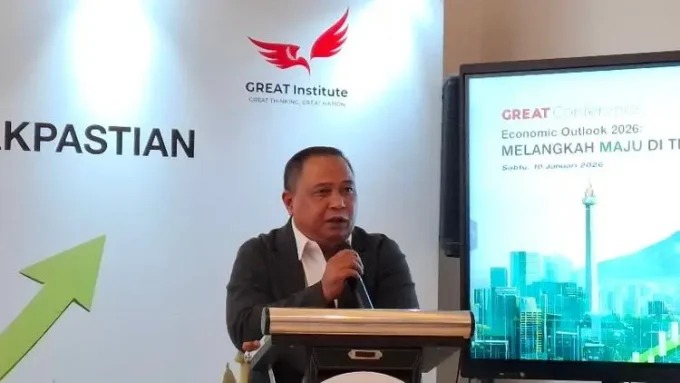
According to GREAT Institute economic researcher Yossi Martino, pressure on the rupiah and capital outflows are natural tests during a period of economic transformation. He argues that the government is shifting from an economic model that has long relied on orthodox macroeconomic stability and market-driven mechanisms toward a Developmental State model in which the state plays a more active role in directing economic development.
Under this new paradigm, the state functions not only as a regulator but also as an active driver of economic transformation. Strategic initiatives such as the Free Nutritious Meals Program (MBG), the establishment of Danantara, industrial downstreaming, food security programs, and more integrated management of natural resources are viewed as components of a long-term effort to build a more self-reliant national economy.
However, such paradigm shifts are not always immediately embraced by financial markets. Markets tend to respond cautiously when significant policy changes occur. Pressure on the rupiah, stock market corrections, and foreign capital outflows reflect an adjustment process that is currently underway. Under these conditions, what is being tested is not only the strength of economic fundamentals but also confidence in the government’s ability to implement its transformation agenda consistently.
Many observers argue that credibility has become a decisive factor. Markets do not focus solely on macroeconomic indicators such as growth, inflation, or foreign exchange reserves. They also evaluate policy consistency, institutional coordination, and the government’s ability to manage risks throughout the transition process. Maintaining economic credibility has therefore become just as important as maintaining economic stability itself.
Pressure on the rupiah has also emerged amid increasing global uncertainty. Geopolitical conflicts, elevated global energy prices, persistently high international interest rates, and shifts in global capital flows have affected many emerging economies. In this context, Indonesia is not facing challenges that are entirely different from those experienced by other countries. Nevertheless, domestic policy responses remain the key factor shaping market perceptions of Indonesia’s future economic prospects.
At the same time, several economists emphasize that the success of economic transformation cannot be measured solely by short-term market reactions. Development programs designed to strengthen state capacity, expand public access to essential services, increase the value added of natural resources, and strengthen domestic industries require time before their full benefits become visible. As a result, market fluctuations during a transition period do not necessarily reflect the success or failure of the policy direction being pursued.
Nevertheless, the government is expected to maintain public and investor confidence through clear communication, transparent governance, and strong coordination between fiscal and monetary policies. Confidence remains a fundamental pillar of economic stability. When markets observe consistency between development objectives and policy implementation, confidence can be strengthened even when short-term pressures persist.
Ultimately, pressure on the rupiah and foreign capital outflows represent not only a test for financial markets but also a test of Indonesia’s broader economic credibility. The transition toward a more active development model that prioritizes national interests requires policy consistency, effective execution, and strong confidence from both the public and economic actors. In this context, the challenge is not merely about exchange rates or capital flows, but about maintaining confidence that the transformation currently underway can build a stronger economic foundation for the long term.
Sources
• Kontan – Rupiah Weakness Considered a Natural Consequence of the Shift Toward Pancasila Economics
• Investor.id – Testing Indonesia’s Economic Credibility
• ANTARA – Government Urged to Maintain Credibility Amid Economic Pressure
• Warta Ekonomi – MBG and Danantara Viewed as Part of a New Pancasila Economic Order