
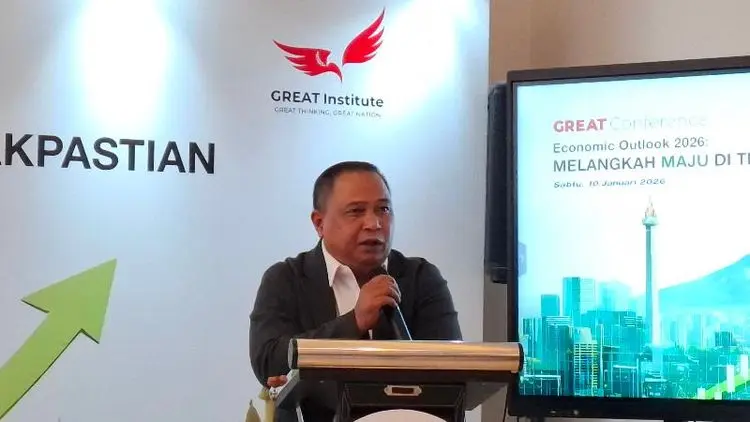

Executive Director of GREAT Institute, Sudarto, stated that the passage of the Domestic Workers Protection Law (UU PPRT) during the plenary session of the Dewan Perwakilan Rakyat Republik Indonesia on Tuesday (21/4/2026) marks an important milestone in the history of domestic labor protection in Indonesia. After spending years on the legislative agenda without certainty, the regulation has finally gained strong political legitimacy.
An important role in accelerating the ratification process cannot be separated from Deputy Speaker of the House Sufmi Dasco Ahmad, who chaired the plenary meeting with the Legislative Body on Monday (20/4/2026). His leadership was considered successful in bridging political dynamics and encouraging cross-faction consensus until the bill was passed at the plenary level.
“GREAT Institute appreciates the leadership of Prof. Sufmi Dasco Ahmad as Deputy Speaker of the DPR RI in successfully passing the UU PPRT. The ratification of the UU PPRT demonstrates political support for vulnerable groups, while also strengthening the image of the DPR RI as an institution that is responsive to issues of social justice. From a public policy perspective, this is also a signal that the state is beginning to pay greater attention to the informal labor sector, which has long been marginalized,” Sudarto emphasized on Wednesday (22/4/2026).
Sudarto viewed the move as concrete evidence of the DPR’s commitment to delivering justice for workers who have long operated in the informal sector with minimal protection.
“With the passage of the UU PPRT, domestic workers—most of whom are women—now have a clear legal foundation. This is not only about protection, but also about recognition of their dignity and contribution to the domestic economy,” Sudarto stated.
Before the UU PPRT was enacted, domestic workers were often placed in structurally vulnerable positions. The absence of a specific legal framework meant that employment relations between employers and domestic workers tended to remain informal, without clear standards regarding working hours, wages, or other basic rights.
“Various reports have shown practices of excessive work without compensation, lack of days off, unilateral wage deductions, and even cases of violence that were difficult to prosecute legally. In this context, the absence of regulation created a gray area that disadvantaged workers. The UU PPRT is here to close that gap,” Sudarto explained.
Sudarto further elaborated that the regulation contains several important provisions that have long been key demands of domestic worker advocacy groups, including:
- Certainty regarding working hours and humane rest periods;
- The right to leave and holiday bonuses (THR);
- A prohibition on unilateral wage deductions;
- Access to social security, including BPJS Kesehatan and BPJS Ketenagakerjaan;
- Protection from physical, psychological, and exploitative abuse.
“These provisions are more than just legal norms. They reflect a paradigm shift: from viewing domestic workers as merely ‘helpers’ to recognizing them as workers who possess equal rights and protections as those in other sectors,” Sudarto concluded.
The article was published on SINDOnews.com