

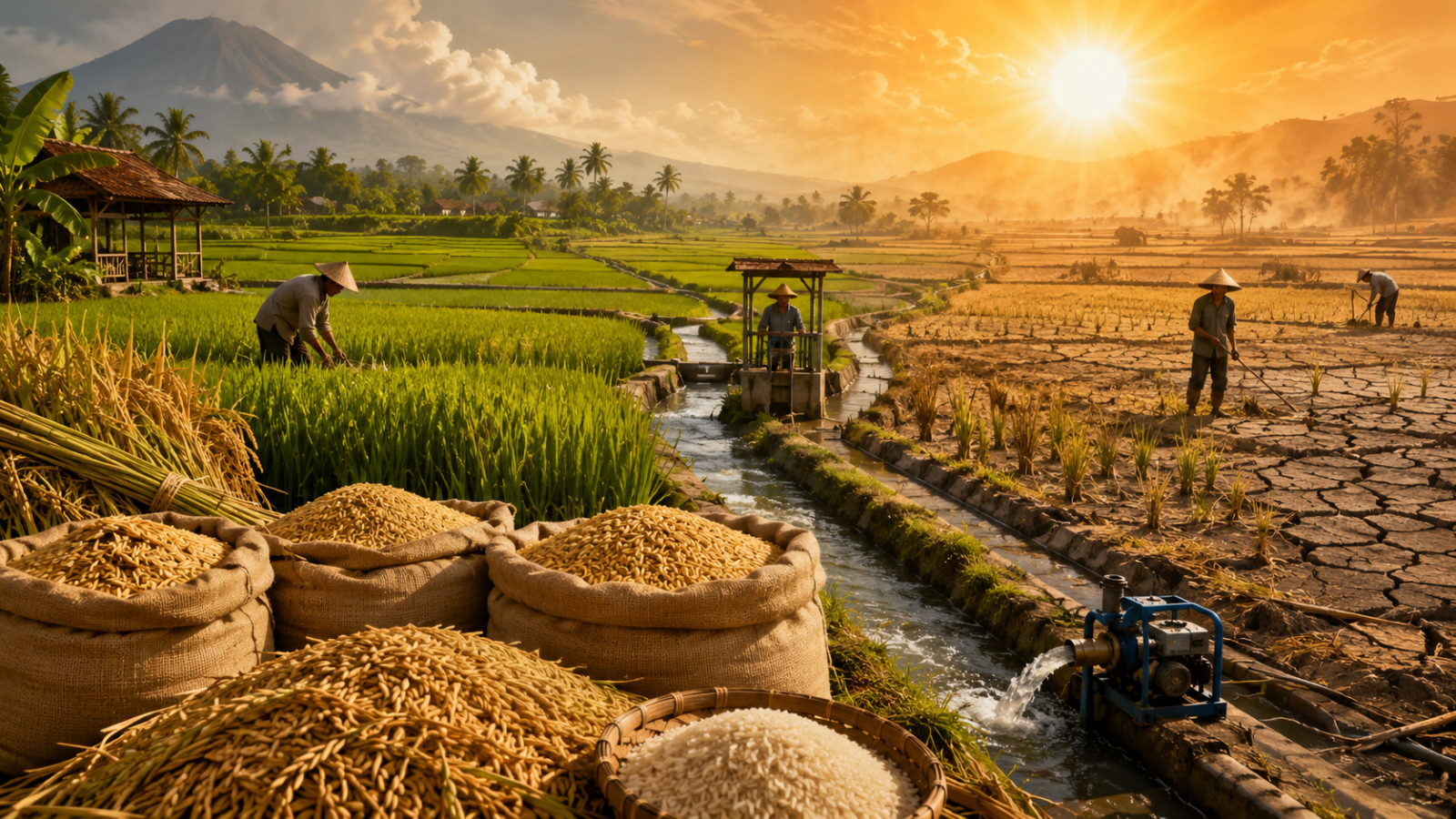

Indonesia is entering the 2026 El Niño episode from a relatively stronger food-security position than in previous periods. Amid the government’s efforts to strengthen national rice production and its declaration that Indonesia achieved rice self-sufficiency in 2025, GREAT Institute has warned that the national surplus does not eliminate risks to the food sector. El Niño, which according to BMKG monitoring cited in the reports has reached a very strong category and could persist until early 2027, may once again test Indonesia’s ability to maintain paddy production across different regions.
The risk is among the strategic-sector issues examined in GREAT Mid-Year Economic Outlook 2026: Rebuilding Trust, Fostering Optimism. GREAT Institute considers Indonesia’s current food position stronger than during the 2023–2024 El Niño episode. However, national production and surplus figures need to be interpreted carefully because aggregate numbers can conceal significant differences in production vulnerability between regions.
Statistics Indonesia data cited in the analysis recorded national rice production of approximately 34.7 million tons in 2025. This exceeded the National Food Agency’s projected domestic rice consumption requirement of 31.2 million tons, leaving Indonesia with a surplus of more than 3.5 million tons. This position was one factor allowing the government to refrain from general rice imports throughout 2025, while it continues to project that general rice imports will not be needed in 2026.
GREAT Institute economist Dr. Hastuti considers both national rice production and reserves to remain within a safe range. The 2025 surplus provides the government with greater room to respond to climate disruptions than during the 2023–2024 El Niño episode. Nevertheless, a relatively secure national position should not reduce vigilance. Precise mitigation of paddy production remains necessary because drought affects different regions in different ways.
These regional differences were evident during the previous El Niño episode. GREAT Institute’s analysis of 2023–2024 found that six provinces—Jambi, Central Kalimantan, South Kalimantan, North Kalimantan, Maluku, and North Maluku—experienced production contractions exceeding 10 percent. In those provinces, the decline in production was driven more by reductions in harvested area than by lower productivity per hectare.
Productivity actually increased in three of the six provinces. This finding indicates that El Niño-related production disruption does not necessarily mean that yields per hectare decline. Risks can also arise when farmers postpone planting, decide not to plant, or when the area of farmland with sufficient water supply decreases. Maintaining water availability and harvested area therefore becomes particularly important during drought conditions.
At the same time, the percentage decline in production is not the only measure that matters. Major rice-producing regions such as Central Java, East Java, and West Java recorded substantially larger production losses in absolute volume, even though their percentage declines were smaller than those of the six highly affected provinces. This demonstrates the importance of assessing food-security risk from both the relative vulnerability of each region and the scale of its contribution to national production.
During the 2023–2024 El Niño episode, Central Java alone lost approximately 736,000 tons of production compared with the baseline period. That loss was more than twice the combined reduction recorded by the six provinces where production fell by more than 10 percent. The finding shows that a relatively modest percentage decline in a major production center can still have significant national implications because of the region’s much larger production base.
For this reason, the national rice surplus cannot be treated as the sole indicator of food security. Aggregate conditions can appear strong while production risks remain concentrated in particular regions. Disruptions to major production centers can create significant national losses, while regions that are particularly vulnerable to drought can experience more severe local problems related to production and supply.
The lessons from the previous episode are considered increasingly relevant to conditions in 2026. According to BMKG monitoring for August 2026 cited in the reports, low rainfall conditions have come to dominate more than 90 percent of Indonesia. The current El Niño episode is also projected to continue until early 2027, making preparation for upcoming planting periods increasingly important.
GREAT Institute argues that the risk posed by El Niño cannot be completely eliminated. Since the intensity of the risk is already known, attention should focus on reducing its impact through accurate policy implementation. Irrigation infrastructure readiness and the distribution of agricultural production inputs across Indonesia are therefore central to mitigation, particularly in regions approaching their next planting period.
The government has already implemented several measures to safeguard production. These include accelerating the construction, improvement, rehabilitation, operation, and maintenance of irrigation networks under Presidential Instruction No. 2 of 2025. Irrigation is particularly important because the previous El Niño episode demonstrated that reductions in harvested area can be a major source of production contraction in vulnerable regions.
In addition to strengthening irrigation networks, the government is implementing pumping programs to supply water to farmland facing shortages. National allocations of subsidized fertilizer for the 2026 planting season are also being implemented. GREAT Institute nevertheless emphasizes that the existence of these programs alone is not sufficient. Their distribution and execution need to match the specific needs and vulnerabilities of individual regions.
Mitigating El Niño also extends beyond maintaining production volumes. GREAT Institute has called on the government to pay close attention to rice price stability at the consumer level. Climate conditions are not the only factor affecting rice prices, but disruptions to either production or distribution could intensify price pressures as the effects of El Niño become more pronounced.
The government is therefore expected to deploy both technical and non-technical measures to protect consumers against excessive rice price increases. Price stability is an essential component of food security because adequate national stocks may not fully protect households if prices in particular regions rise due to localized production or distribution disruptions.
Higher rice prices can also affect household spending patterns. As food costs increase, families may have to allocate a larger share of their income to basic necessities, leaving less room for other expenditure. The pressure can be especially severe for vulnerable households because they have less flexibility to adjust their spending.
Against this background, GREAT Institute has proposed three additional mitigation measures.
First, the advance placement of Government Rice Reserves and agricultural production inputs for emergency conditions should be specifically prioritized in regions with a history of high vulnerability. A substantial national surplus does not automatically mean that reserves are distributed evenly across the country. Pre-positioning reserves before disruptions intensify can therefore help reduce distribution risks.
Second, the government should adopt a more comprehensive approach to the technical factors affecting production resilience. Irrigation infrastructure remains important, but the characteristics of individual regions also need to be considered. GREAT Institute recommends mapping production vulnerabilities at the regional level as a basis for setting intervention priorities.
Such mapping could allow support to be adjusted according to local requirements, including the distribution of production inputs, access to financing, and technical assistance. The approach recognizes that a uniform policy may not produce the same outcome everywhere because water availability, planting patterns, harvested areas, and production vulnerabilities differ significantly between regions.
Third, GREAT Institute recommends strengthening rice price monitoring at the provincial level. A national rice surplus does not automatically prevent price pressures from emerging in particular areas when production or distribution is disrupted. Price developments therefore need to be assessed alongside local production conditions, reserve availability, and distribution performance.
A regional approach is particularly important because El Niño can generate very different impacts even while Indonesia’s overall food position remains relatively secure. Some provinces may suffer sharp percentage declines because of reduced harvested areas, while major production centers may experience larger losses in absolute volume despite smaller percentage contractions. Such differences mean that uniform mitigation measures may fail to address each region’s specific vulnerabilities.
Indonesia’s 2025 rice production performance nevertheless represents an important achievement that provides the country with a stronger starting position for the current El Niño episode. Production of approximately 34.7 million tons and a surplus exceeding 3.5 million tons give the government a larger buffer than during the previous episode. GREAT Institute stresses, however, that this stronger national position should be used to reinforce preparedness rather than justify complacency over regional vulnerabilities.
Indonesia’s challenge in confronting El Niño is therefore not simply whether the country has sufficient rice stocks at the national level. It also involves maintaining harvested areas, ensuring farmland continues to receive sufficient water, distributing agricultural inputs to the regions that need them, positioning reserves appropriately, and keeping distribution functioning so that production disruptions do not translate into excessive price increases for consumers.
The rice surplus gives the government a stronger position from which to manage the risks ahead. However, food security throughout the El Niño period will ultimately depend on how precisely mitigation measures are implemented in the field. Regional differences, irrigation readiness, agricultural inputs, reserve management, and price stability need to be treated as interconnected elements so that strong national production can translate into genuine protection for households throughout the period of extreme climate conditions.
Sources:
- Tribunnews – 3.5 Million-Ton Rice Surplus Faces El Niño Threat, Government Urged to Remain Vigilant
- SINDOnews – Precise Mitigation Needed as El Niño Tests Regional Paddy Production Resilience
- El Niño Threat Amid Indonesia’s Rice Surplus
- Industry.co.id – GREAT Institute: Precise Mitigation Needed as El Niño Tests Indonesia’s Regional Paddy Production Resilience
- ANTARA – GREAT Institute: Precise Paddy Production Mitigation Remains Necessary
- Yogya Pos – Precise Mitigation Needed as El Niño Tests Indonesia’s Regional Paddy Production Resilience