

Productive Corrections: The Ministry of Immigration and Corrections’ Strategy to Reduce Recidivism and Promote an Inclusive Economy Based on Restorative Justice
Jakarta – The transformation of the correctional system initiated by the Ministry of Immigration and Corrections (Kemenimipas) is now increasingly directed toward a productive approach based on data and real economic needs. This policy not only emphasizes rehabilitation, but also the creation of economic value from inmates, while integrating the principles of restorative justice.
Speaking in Jakarta on April 22, Special Staff to the Minister of Immigration and Corrections, Abdullah Rasyid, stated that correctional reform must be viewed as part of a national development strategy that is inclusive, sustainable, and oriented toward social recovery.
“Productive corrections are not merely a social program, but part of a grand design to reduce recidivism through economic approaches and the restoration of social relationships. Data shows that skills and access to employment are key factors in successful reintegration,” he said.
Based on data from the Directorate General of Corrections (Ditjen PAS) up to 2025, the number of inmates in correctional institutions and detention centers in Indonesia has reached more than 270,000 people, while the ideal capacity is only around 140,000, meaning overcrowding exceeds 90 percent. This condition poses a serious challenge in optimizing rehabilitation as well as implementing ideal restorative justice.
However, amid these limitations, self-reliance development programs have shown progress. Approximately 70,000 inmates have participated in various vocational training and productive activities, ranging from agriculture, fisheries, and handicrafts to small-scale manufacturing.
From an economic perspective, the contribution of inmate business activities has also started to become visible. Previous Ministry data showed that Non-Tax State Revenue (PNBP) from the correctional sector, including products made by inmates, reached around IDR 60–80 billion per year, with an increasing trend alongside the expansion of productive rehabilitation programs.
According to Abdullah Rasyid, these figures still have significant room for improvement, especially if supported by strategic partnerships with the business sector.
“Imagine if 20–30 percent of the total inmate population could enter a standardized production ecosystem. This is not only about rehabilitation, but also about real economic potential,” he said.
On the other hand, data shows that the recidivism rate in Indonesia remains around 15–20 percent, largely driven by economic factors and limited access to employment after release.
Therefore, Kemenimipas is now promoting a link-and-match model between prison training programs and labor market needs. This program is strengthened through collaboration with the private sector, certification-based training, and the development of prison industries.
Integration of Restorative Justice Principles
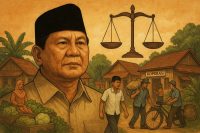
In line with the new paradigm in Indonesia’s New Criminal Code (KUHP), the productive corrections approach is also directed toward implementing the principles of restorative justice, namely the resolution of criminal cases by emphasizing the restoration of relationships between offenders, victims, and society.
In this context, rehabilitation programs inside prisons aim not only to create work skills, but also to achieve:
- Restoration of the offender’s moral responsibility through legal and social awareness programs
- More humane social reintegration by reducing stigma against former inmates
- Economic empowerment as a form of social reparation, where inmates can contribute positively to society
This approach strengthens the function of corrections not merely as a punitive system, but as a rehabilitative and restorative system.
In addition, restorative justice practices also create opportunities for the development of programs such as penal mediation, productive community service, and community involvement in the reintegration process. This is believed to reduce the potential for recidivism more sustainably compared to conventional approaches.
Economic and Social Impact
This approach also creates a multiplier effect for regional economies. Products resulting from inmate rehabilitation programs have begun entering local and national markets, strengthening the MSME sector and the people’s economy.
Furthermore, the integration of restorative justice with productive corrections creates a development model that is not only oriented toward economic growth, but also toward social justice.
Nevertheless, Rasyid acknowledged that structural challenges remain significant, ranging from budget limitations and the quality of training facilities to the still-imbalanced ratio between officers and inmates.
“Of course, we do not ignore the challenges. But the policy direction is already clear: corrections must be productive, adaptive, connected to the economic system, and grounded in the principles of restorative justice,” he emphasized.
Future Policy Direction
Going forward, with increasingly strong data foundations and cross-sector synergy, Kemenimipas is optimistic that productive corrections based on restorative justice can become one of the effective instruments for reducing recidivism, strengthening social cohesion, and creating new sources of inclusive economic growth in Indonesia.