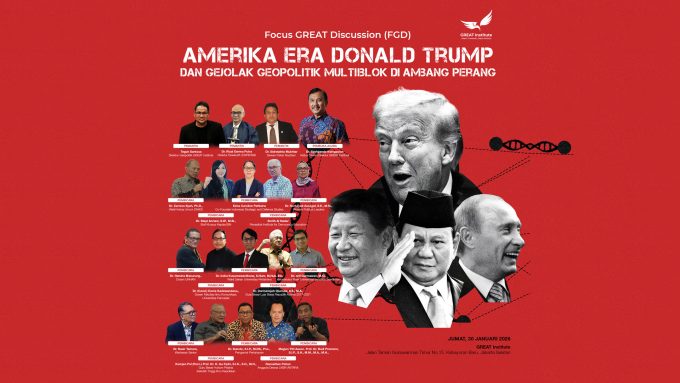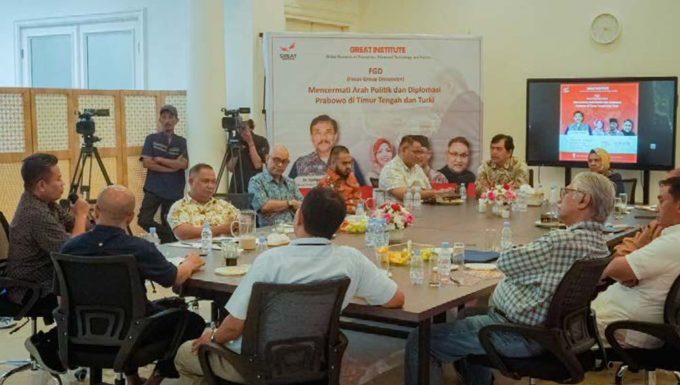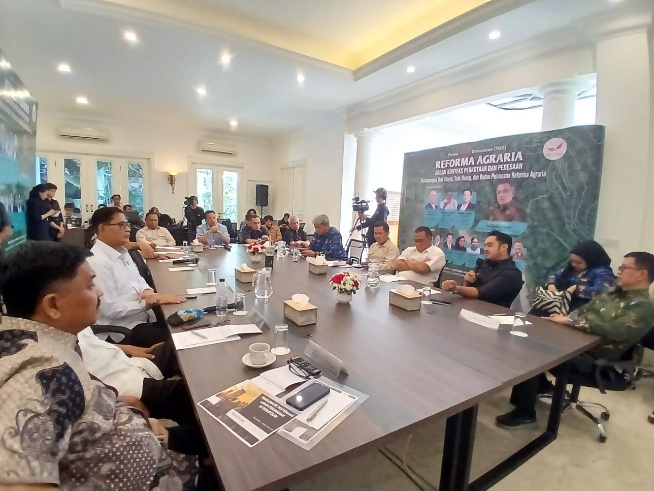

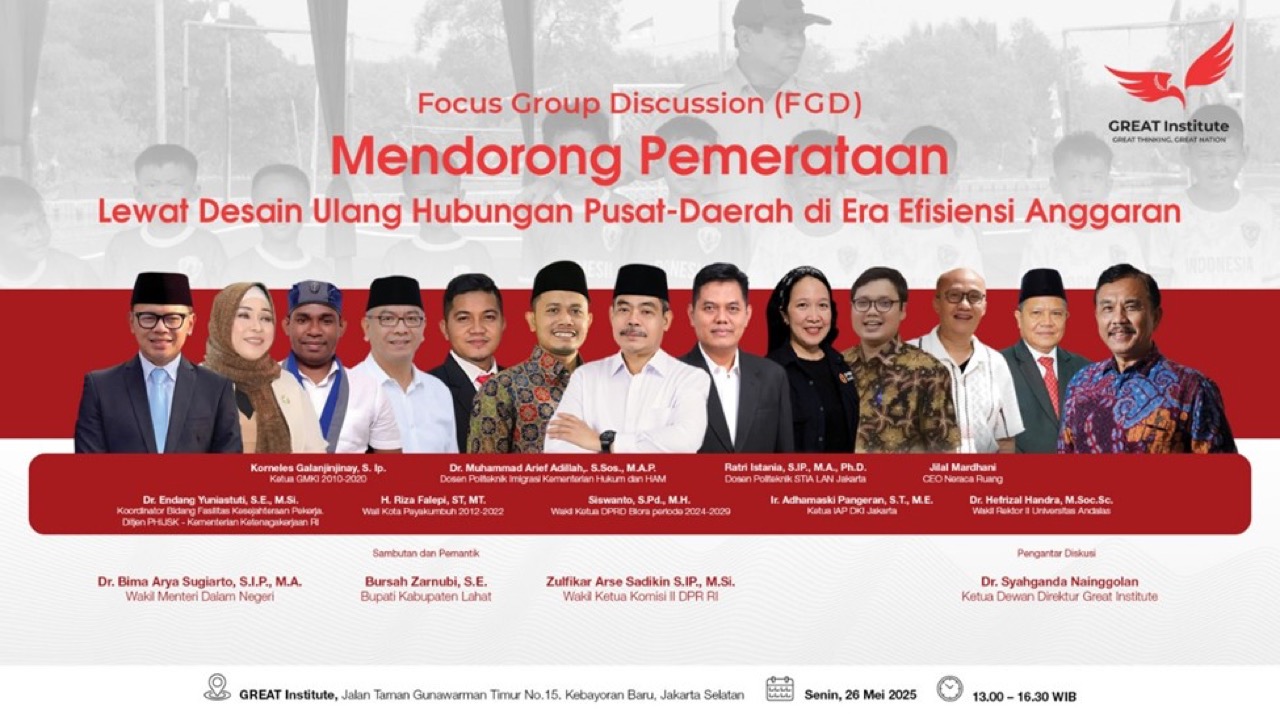

Regional autonomy today is not freedom, but a tug-of-war between the central and regional governments. This is the subtle yet piercing conclusion of the Focus Group Discussion organized by GREAT Institute, titled “Promoting Equity Through Redesigning Central–Regional Relations in the Era of Budget Efficiency.”
The discussion was opened by moderator Ir. Hendry Harmen with an initial statement that struck a nerve: six regions in Java contribute more than 56 percent of the national Gross Domestic Product, while the rest are left behind in inequality of public services and fiscal dependence on the central government. “Those regions live off revenue-sharing funds,” he said.
Chairman of the Board of Directors of GREAT Institute, Dr. Syahganda Nainggolan, opened the forum with a somber tone: many regional leaders complain that the sharp edge of their autonomy has been blunted. “Permitting authority, resource management—all of it is pulled back to the center. Even for C-class mining materials, permits must come from the central government,” he said. He emphasized that this FGD is not merely a discussion forum, but a serious effort by GREAT to present critical thinking for a new direction in governance.
Deputy Minister of Home Affairs, Bima Arya, did not deny the imbalance. He conveyed President Prabowo Subianto’s message in a cabinet meeting a few weeks earlier, when the president showed a photo of a young girl named Naila. “Ladies and gentlemen ministers, let us make Naila and all children across Indonesia smile,” Bima quoted. He stressed that the Prabowo administration is anti-liberalism and defines itself as social democratic—a direction pioneered by Sutan Sjahrir and Mohammad Hatta.
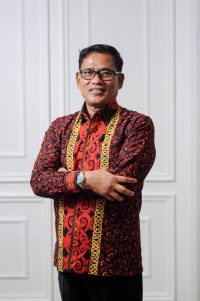
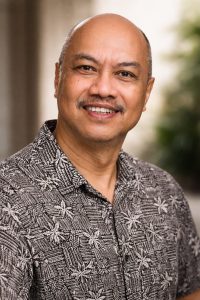
However, that dream will fail, said Bursah Zarnubi, if the state structure remains blocked. “The current autonomy is only pseudo-autonomy. The tail is still held by the center,” said the Regent of Lahat, also known as a political thinker since the 1980s. He cited Gunnar Myrdal, who described rural poverty in Asia as the result of the absence of a spread effect from urban areas.
“Sixty percent of government programs are at the district/city level, but they only receive crumbs. As a result, many regional leaders are trapped in corruption due to continuous financial pressure,” he said. Bursah also described the Job Creation Law as a regulation that undermines the spirit of decentralization. “It must be revoked,” he stressed.
A similar statement came from Ratri Istania, Ph.D., lecturer at STIA LAN Jakarta. She reminded participants that the roots of regional autonomy did not begin in 1998, but far earlier. “Even in the Dutch colonial era, the colonial government created a decentralization law because managing the Dutch East Indies from The Hague was unreasonable,” she said. But according to her, autonomy is now being stripped away. Even the idea of returning regional head elections to regional councils has resurfaced. “That is history—do not repeat it.”
Ratri added that between 2015 and 2019, the number of political dynasties increased by 300 percent. “And five percent of those dynasties increased poverty rates,” she said. Autonomy is not only about who elects leaders, but how power is used.
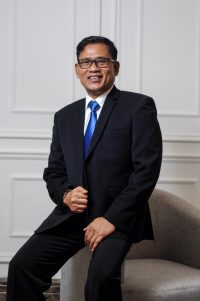
Meanwhile, Dr. Arief Adillah from the Ministry of Law and Human Rights revealed another dark side of autonomy: low literacy and weak regional capacity. “Even regions that receive national literacy awards are, in reality, in poor condition,” he said. He identified five main problems of decentralization: low capacity, corruption, development gaps, weak coordination, and limited natural and human resources. He suggested that IPDN graduates should first be placed as village secretaries. “Manage finances from the ground level; that is where they learn integrity,” he said.
However, one of Arief’s statements drew enthusiasm from participants: “Rather than asking for independence, it is better to ask for new autonomous regions!” He said there are currently 341 proposals for new autonomous regions: 42 provinces, 252 districts/cities, and several special and unique regions.
Of course, all of this cannot be answered with rhetoric alone. As Bima Arya concluded: “We need agglomeration as centers of growth. But there is a challenge: there are 1,065 regional-owned enterprises, most of them unhealthy.”
Tito Sulistyo, Chair of the Supervisory Board of the Financial Services Authority (OJK), also pointed out the fact that 70 percent of state-owned enterprise offices are still concentrated in Jakarta. “Where is the logic? Pertamina should be in East Kalimantan, not in the Kuningan area.”
The forum reflected a silent consensus: that autonomy is not a gift, but a resistance against an ever-expanding centralism. As Václav Havel wrote, “The salvation of this human world lies nowhere else than in the human heart, in the human responsibility.”
And perhaps, the salvation of this republic can only begin with the courage of regional leaders to speak out.