
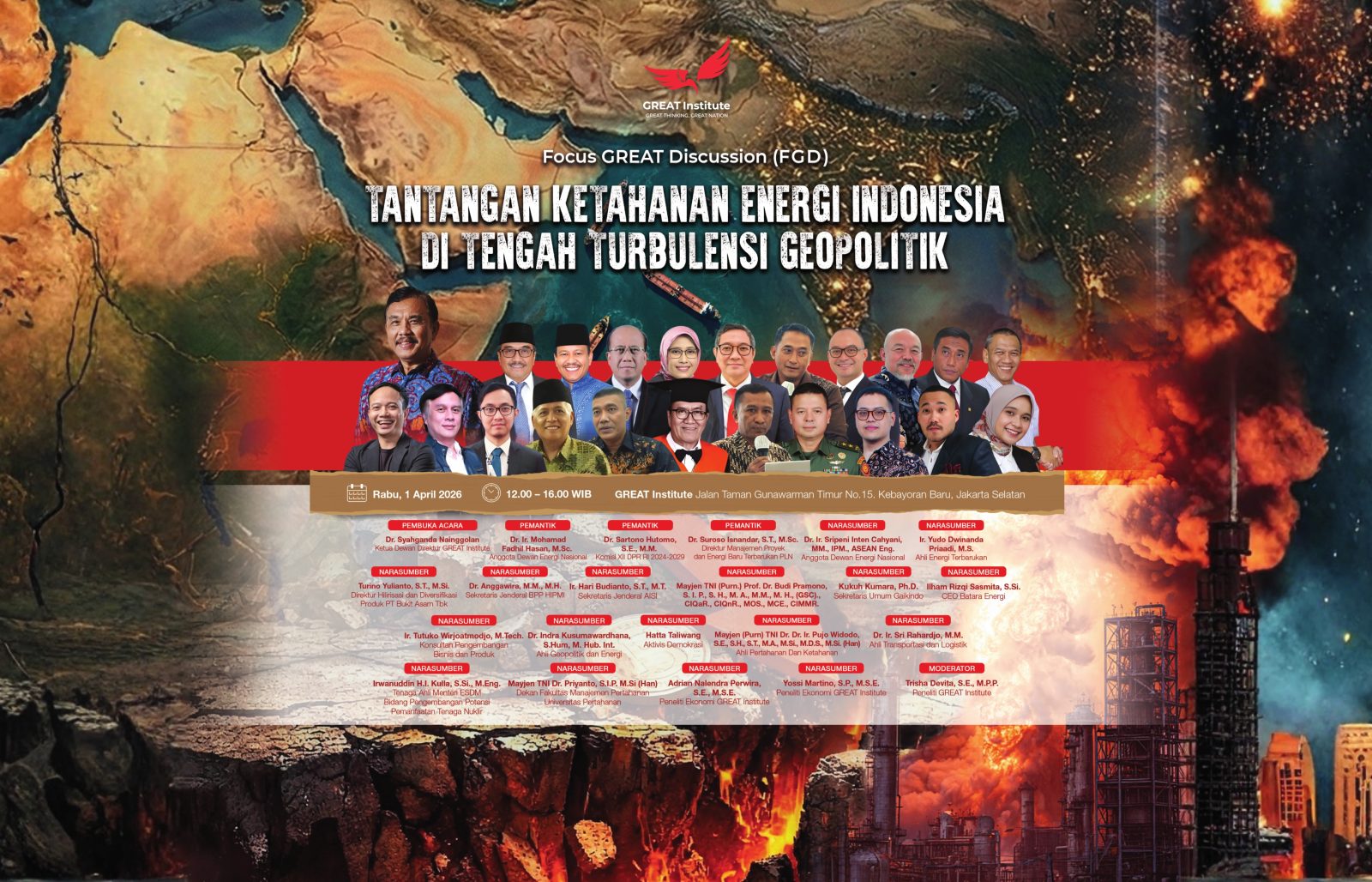

JAKARTA — “This is an effort and contribution from the GREAT Institute to address national issues that we are currently facing—and may continue to face in the future in line with global geopolitical developments,” said Chairman of the Board of Directors of GREAT Institute, Dr. Syahganda Nainggolan, opening the Focus GREAT Discussion (FGD) titled “Indonesia’s Energy Security Challenges Amid Geopolitical Turbulence,” on Wednesday (1 April 2026) in Jakarta.
That tone was not merely a formal opening remark. Syahganda immediately linked the forum to the ongoing global turmoil. “It cannot be denied that the world is currently facing energy-related problems due to the war in the Middle East. We can see that neighboring countries have already begun experiencing increases in fuel prices as a direct impact of the Iran–Israel–United States war,” he said.
FGD attended by dozens of participants brought together a number of names that frequently appear in the public sphere—from energy experts, economists, officials, to industry actors. Among those present were Yudo Dwinanda Priaadi, Irwanuddin Kulla, Indra Kusumawardhana, Mohamad Fadhil Hasan, Kukuh Kumara, Ilham Rizqi Sasmita, Hari Budianto (Secretary General of AISI—Association of Indonesian Motorcycle Industry), Major General TNI Priyanto, Pujo Widodo, Anggawira, and Sripeni Inten Cahyani who joined virtually. The discussion was moderated by GREAT Institute researcher, Trisha Devita.
The presentation by the GREAT Institute Economic Team became one of the main reference points of the discussion. They emphasized that the surge in global oil prices due to conflict is no longer merely a geopolitical issue, but has turned into a direct fiscal pressure on Indonesia.
In the material presented, global oil prices had at one point surged to nearly 120 USD per barrel, far above the 2026 State Budget assumption of only 70 USD.
“Indonesia will definitely be affected by this war,” said GREAT Institute researcher Yossi Martino. “Global turbulence due to rising oil prices has a real impact on our economy.”
In one of the worst fiscal deficit scenarios prepared by GREAT, the budget deficit could widen to between 3.80 percent and 4.30 percent of GDP, assuming oil prices remain in the range of USD 105–120 per barrel. This pressure does not stand alone. The presentation also showed that every 1 USD increase in oil prices can add trillions of rupiah in energy subsidy burdens, while simultaneously narrowing the state’s fiscal space.
On the other hand, Indonesia is in a vulnerable position because its national energy reserves are relatively thin—around 20–25 days of consumption, far below the ideal standard of 90 days as recommended internationally.
Member of the National Energy Council, Mohamad Fadhil Hasan, emphasized that the government is currently still at the mitigation and adaptation stage. “One of the tasks of the DEN is to determine energy crisis response measures as advice to the President,” said Fadhil.
He explained that the reference for energy crisis conditions refers to Presidential Regulation No. 22 of 2017 on RUEN and Government Regulation No. 79 of 2014. One indicator is a disruption in fuel supply for seven consecutive days. “Based on identification, our fuel reserves are still safe according to Pertamina. So the steps taken are still mitigation and adaptation,” he said.
However, in parliament, a more cautious tone was expressed. Member of Commission XII of the Indonesian House of Representatives, Sartono Hutomo, reminded that fiscal pressure cannot be avoided. “Our State Budget assumption is 70 USD per barrel, while reality is much higher. The House appreciates that there has been no fuel price increase, but this is only shifting the burden,” said Sartono.
According to him, without structural measures, the pressure will shift to other sectors. “There must still be price adjustments in the future. Policy credibility and transparency will be key.”
From a defense perspective, Major General TNI Priyanto, Dean of the Faculty of Defense Management at UNHAN, noted that Indonesia is not only a price taker but also a risk taker. “Because we are net importers, when distribution is disrupted, the impact is not only economic, but also social and defense stability,” said Major General Priyanto. He stressed that Indonesia cannot merely manage crises but must build a resilient system. “Energy resilience transformation is not an option, but a necessity.”
A similar view was expressed by Major General (Ret.) Pujo Widodo, who highlighted the limitations of national energy endurance. “Our resilience is around 21 days, while global oil prices once reached 120 USD per barrel,” said Pujo, the defense and security expert. He encouraged energy source diversification, expansion of import partners, and strengthening the security of global energy supply routes.
From the industrial and technological side, the discussion became more concrete. Renewable energy expert Yudo Dwinanda Priaadi saw this condition as an opportunity. “This is the right time for accelerating new energy, including solar power plants and even nuclear power plants. We must not lose this momentum,” he said. Yudo also emphasized the importance of electrification and battery-based energy storage technology.
Meanwhile, Turino Yulianto from PT Bukit Asam stressed that coal remains the backbone of national alternative energy. “Our coal production is 817 million tons per year, with nearly 100 billion tons in potential. This must be processed domestically,” said Turino. He encouraged the acceleration of coal gasification as a substitute for LPG, considering Indonesia imports millions of tons of LPG annually.
In the transportation sector, Kukuh Kumara from Gaikindo said that the industry is actually ready to adapt. “We already produce engines that can use E85 and export them to Brazil. It just depends on fuel availability,” he said.
A similar view was expressed by Hari Budianto from AISI. “Motorcycles are the backbone of the people’s economy. Since 2005, we have been able to use ethanol blends of E5 to E10 without engine modification.”
From a socio-economic perspective, Chairman of KSPSI, Jumhur Hidayat, took a more pragmatic position. “In my opinion, there is no problem if fuel prices go up first; after the war, they can go down again, rather than a growing deficit,” said Jumhur.
He also saw opportunities within the crisis. “Technical workers actually gain opportunities because they are needed to mitigate the energy crisis.”
The discussion also highlighted the need to change public energy consumption patterns. The study presented showed that the transportation sector remains the largest consumer of fuel, including the dominance of private vehicles. This makes the transition to alternative energy, including electric vehicles and biofuels, increasingly urgent.
The intense FGD eventually did not stop at diagnosing problems. A number of recommendations emerged—from subsidy control, state spending efficiency, to the establishment of a special task force to maintain fiscal and energy stability.
However, above all, one strong common thread emerged: Indonesia can no longer postpone structural energy reform.
As the afternoon approached, the discussion ended in a more relaxed atmosphere. Participants engaged in informal conversations during a post-Ramadan gathering in the spirit of Eid al-Fitr 1447 H, still warmly felt in the public space. Amid laughter and handshakes, one awareness quietly settled: the energy crisis is no longer a distant threat on the horizon. It is already standing at the door—and the available choice is no longer to wait, but to prepare.
Terms of Reference Focus GREAT Discussion
Indonesia’s Energy Resilience Challenges Amid Geopolitical Turbulence
Background
In recent years, Indonesia’s energy resilience has faced increasingly complex and multidimensional pressures arising from global dynamics, domestic limitations, and unresolved structural issues. As a country that has been a net oil importer since 2004, Indonesia has a high level of exposure to global energy price fluctuations and international supply chain disruptions.
This vulnerability is becoming more apparent in the context of escalating global geopolitics. The Strait of Hormuz, through which around 20 percent of global oil trade passes, is one of the critical points in the global energy system. Tensions in the Middle East during the 2025–2026 period have driven global oil prices to above USD 100 per barrel, reflecting the high geopolitical risk in energy price formation. This condition shows that Indonesia’s energy supply stability is not only determined by domestic capacity but is also strongly influenced by external dynamics beyond national control.
On the domestic side, Indonesia’s energy resilience still faces fundamental challenges in the form of high dependence on energy imports. In 2025, national oil lifting was recorded at around 605 thousand barrels per day, while fuel consumption reached around 232 thousand kiloliters per day. Domestic production can only meet about one-third of demand, so most consumption must be met through imports. This dependence is further exacerbated by mature oil and gas fields, with natural production decline rates reaching 16–20 percent per year without new discoveries or significant technological intervention. This shows that pressure on energy resilience is structural and may increase without strategic measures.
In addition to supply aspects, vulnerability is also reflected in limited national energy infrastructure. Fuel storage capacity of around 20–23 days is below the national minimum standard and far from the international best practice of 90 days of reserves. This limitation increases the risk of supply disruptions, especially during global crises or distribution disruptions caused by natural disasters and climate change.
Pressure on the energy system also affects fiscal conditions. The realization of the 2025 State Budget deficit, approaching the 3 percent of GDP limit at 2.92 percent, indicates limited fiscal space to respond to energy shocks. Meanwhile, energy subsidy spending remains high, reaching IDR 210.1 trillion in 2026, an increase of around 14 percent compared to 2025. However, commodity-based subsidy schemes still face issues of targeting accuracy and have not fully protected vulnerable and poor groups.
In facing these pressures, global experience shows that countries tend to return to the use of the most available domestic energy sources to maintain short-term supply stability. In Indonesia’s context, this is reflected in the strategic role of coal as an abundant energy source, with reserves reaching 31.95 billion tons in 2024 and total resources of 97.96 billion tons. However, coal utilization is still dominated by electricity generation, while downstream potential into value-added products such as synthetic gas (syngas) and Dimethyl Ether (DME) as LPG substitutes has not been optimally utilized.
On the other hand, Indonesia also has broader domestic energy potential, including non-conventional energy sources such as oil shale, estimated at more than 12 billion tons, and tar sand at around 500 million tons. This shows that opportunities to strengthen national energy resilience lie not only in increasing conventional energy production but also in developing technology to optimize alternative resources.
Nevertheless, the national energy system is still dominated by fossil energy, accounting for more than 80 percent of the primary energy mix. Renewable energy development targets have also not been optimally achieved. This is exacerbated by an energy sector governance that remains fragmented and focused on upstream activities, without adequate strengthening in downstream sectors, end-use energy, and technology mastery along the value chain.
Considering these challenges, restructuring the national energy system has become increasingly urgent. Diversification of domestic resource-based energy sources must be prioritized to reduce import dependence and increase system flexibility in facing various risks. The use of electrical energy, including the development of renewable energy such as solar power, needs to be significantly expanded. In addition, long-term options such as nuclear energy also require attention as part of national energy diversification strategy.
In line with this, policy reform is a key element in energy transformation. The shift from commodity-based subsidies to targeted subsidies is necessary to improve efficiency and accuracy. Strengthening regulation, energy technology development, and governance improvement to ensure an energy transition that remains environmentally sustainable are essential prerequisites for building a resilient energy system.
In the medium to long term (5–10 years), national strategy should be directed toward building energy independence based on domestic resources, strengthening the energy industry from upstream to downstream, improving consumption efficiency, and encouraging behavioral changes in energy use. With increasing global risk complexity, transformation of the national energy system is no longer an option but a necessity. Without comprehensive and integrated reforms, Indonesia will remain vulnerable to external shocks, both fiscally and in terms of energy resilience.
Objectives
The objectives of this activity are:
- To identify and analyze vulnerabilities in national energy resilience. Conduct a comprehensive analysis of risks facing Indonesia’s energy system, including import dependence, global geopolitical dynamics, infrastructure and reserve limitations, and risks of disruption due to climate and natural disasters.
- To formulate a direction for an integrated and sustainable national energy system transformation. Develop a medium- to long-term (5–10 years) strategic framework for energy mix diversification based on domestic resources, development of upstream-to-downstream energy ecosystems, strengthening energy technology, and integration of environmental aspects across the entire energy value chain.
- To develop actionable policy recommendations to strengthen national energy resilience. Formulate concrete measures including energy efficiency, strengthening energy regulations and governance, including renewable energy, electricity systems, and future energy options, as well as restructuring energy subsidy policies to make them more targeted and support system sustainability.