

Executive Introduction: Methodology and Key Findings
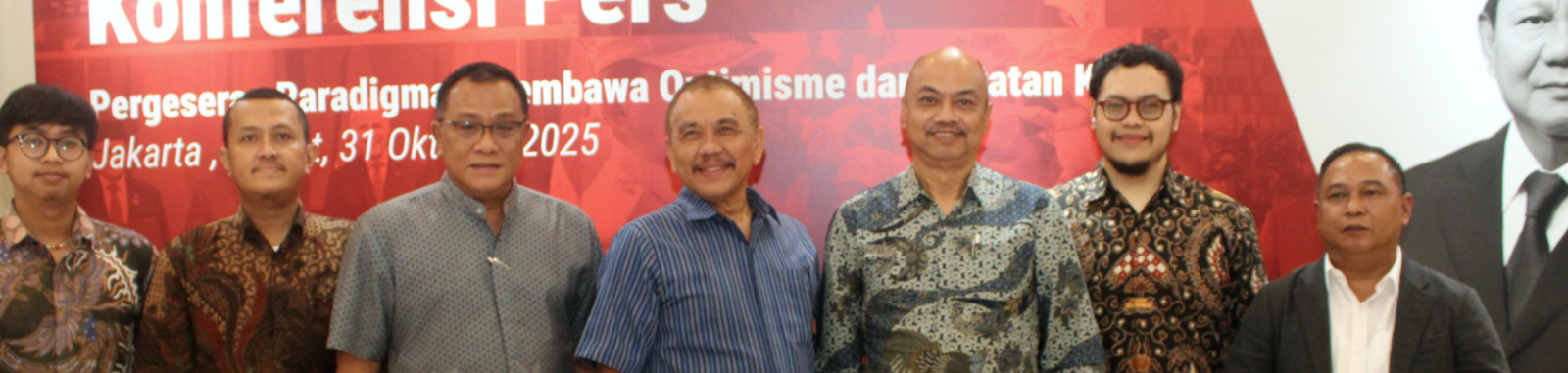
The press conference organized by GREAT Institute on October 31, 2025 in Jakarta, titled “Paradigm Shift: Bringing Optimism and Critical Notes,” became a crucial study evaluating the first year performance of President Prabowo Subianto. The research is based on a robust mixed-method approach: a public opinion survey of 422 Indonesian respondents with a margin of error of ±5%, secondary data from official institutions (BPS, BI, Ministry of Finance), and Big Data analysis of 4.79 million posts across social media and mainstream platforms.
The fundamental finding of this research is a high level of public satisfaction. As many as 85.8% of the public expressed satisfaction with President Prabowo’s overall performance, indicating broad acceptance of the new direction and leadership style. This optimism, according to GREAT Institute, is rooted in a Paradigm Shift in governance—an orientation that moves significantly away from oligarchic or supply-side development toward a People’s Economy model that emphasizes demand-side policies and inclusivity. This essay will examine the drivers of this optimism and critically analyze the implementation challenges that must be addressed.
I. Foundations of Optimism: Economic Paradigm Shift
The economic paradigm shift under President Prabowo’s administration represents a policy reorientation from a supply-side approach focused on capital-intensive investment and oligarchic structures, toward a demand-side People’s Economy approach that prioritizes inclusivity and household-level welfare improvements. This shift is the main foundation of public optimism.
1. The Free Nutritious Meal (MBG) Program as a Demand-Side Intervention
The Free Nutritious Meal (MBG) program is a flagship initiative driving public optimism. It is not merely a social assistance program, but a strategic economic intervention that generates large aggregate demand in the local food sector.
- Awareness and satisfaction: The program achieved a functional satisfaction level of 70.4%. Survey results show that 89.8% of the public consider MBG beneficial.
- Accelerated implementation: MBG implementation reached 36.62% as of October 2025, exceeding the 2025 RPJMN target of 19%.
However, this acceleration must be accompanied by attention to implementation quality and budget absorption. GREAT Institute notes the need for MBG quality evaluation (8.5% public demand for improvement) and low cumulative budget absorption compared to the ideal S-curve projection.
2. Red and White Village Cooperatives (Kopdes) as a Structural Pillar
Kopdes is designed as a structural instrument to support MBG effectiveness and realize a people-centered economy.
- Public confidence: 71.8% of respondents believe Kopdes can strengthen rural economies and expand access to capital.
- Core function: Kopdes acts as a demand aggregation mechanism at the local level, achieving economies of scale and improving efficiency.
- Implementation progress: 17,000 outlets have been established as of October 2025, supported by presidential instructions and financing from state banks and budget surplus (SILPA).
3. Improvement in Household Economy
- Perception of welfare: 71.8% of respondents feel their household economic condition has improved.
- Macro support:
- Farmers’ Terms of Trade (NTP) increased to 124 (September 2025).
- Poverty rate declined to 8.47%, the lowest in history.
4. Purchasing Power and Labor Market Challenges
- Improved purchasing power: 62.1% of respondents feel their purchasing power has improved.
- Labor paradox: Despite low unemployment (4.76%), people still find it difficult to secure formal jobs due to the dominance of the informal sector (~60%).
Recommendation: increase labor-intensive manufacturing investment and create a transparent job dashboard for formal employment.
II. Pillars of Satisfaction: Political Performance and Governance
1. Anti-Corruption Efforts
- 89.8% of respondents are satisfied with anti-corruption efforts.
- Key driver: asset recovery and enforcement actions.
- Corruption remains the top public concern (20.6%).
2. Freedom of Expression (with critical note)
- 81.8% perceive freedom of expression as improved.
- However, concerns remain due to activist arrests following protests, creating public unease.
Recommendation: consider release of political activists not involved in vandalism as a democratic commitment.
3. Foreign Policy and Palestine Issue
- 89.8% satisfaction with foreign policy.
- Strong approval due to Indonesia’s role in Palestinian independence and support for the two-state solution (89.5% agreement).
- Indonesia is seen as an active global peace actor.
4. “Purbaya Effect” and Cabinet Reform
- Finance Minister Purbaya Yudi Sadewa is the most favored minister (score 826).
- Symbolizes reform legitimacy and internal criticism within government.
- 5.0% of respondents call for cabinet reshuffle.
III. Critical Notes and Implementation Challenges
1. MBG Quality and Budget Absorption Paradox
- 8.5% demand for quality improvement.
- Budget absorption remains below the ideal curve, under Rp 1 trillion (as of October 2025).
- Risk: rushed spending may reduce quality or increase imports.
Recommendation: prioritize quality over spending speed and strengthen digital monitoring of Kopdes and MBG funds.
2. Democracy and Cabinet Reshuffle Needs
- 5.0% of respondents support cabinet reshuffle.
- Concerns over ministerial performance and consistency with paradigm shift.
- Recommendation includes ensuring pro-people economic orientation and allowing cooperatives to manage small-scale mining.
Conclusion: Sustaining Quality for Long-Term Success
The first year of President Prabowo’s administration is marked by strong public optimism (85.8%), driven by a paradigm shift toward a people-centered economy, anti-corruption efforts, and active diplomacy.
However, sustainability depends on addressing the gap between quantity and quality—especially in MBG implementation, labor market structure, and democratic safeguards. With continuous self-evaluation and responsiveness to critical recommendations, this paradigm shift has the potential to become a strong foundation for inclusive and sustainable national development.