
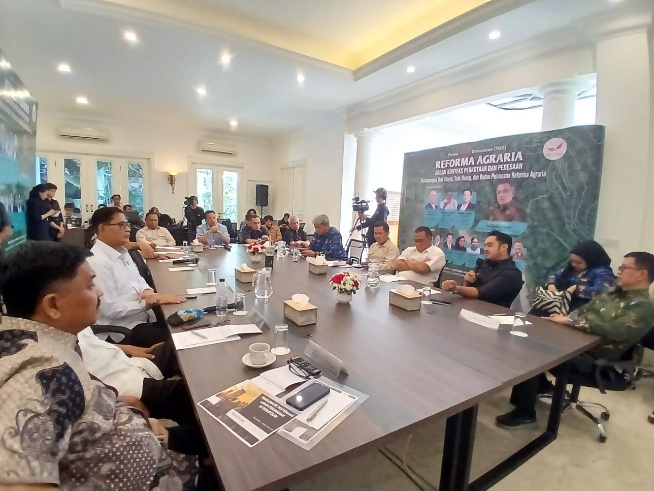

Agrarian Reform in the Context of Urban and Rural Areas: Inequality, Customary Rights, Spatial Planning, and the Agrarian Reform Implementation Agency
Agrarian reform in Indonesia has its historical roots in the Basic Agrarian Law (UUPA) of 1960, which was intended to ensure equal access to land for all citizens. However, after more than six decades, the problem of land ownership inequality remains a structural issue that has not been resolved. The reality shows that access to land, both in urban and rural areas, is still highly unequal.
In urban areas, limited residential land is worsened by spatial planning that tends to favor developers’ interests. As a result, low-income communities increasingly struggle to obtain adequate and affordable housing. Meanwhile, in rural areas, most farmers remain landless, meaning they do not own land, so land distribution remains unequal and contributes to low farmer welfare.
On the other hand, customary land rights (hak ulayat) of indigenous communities are also increasingly weakened due to various sectoral regulations that often overlap with national agrarian principles. The weakening of these customary rights not only reduces indigenous communities’ sovereignty over their living spaces, but also triggers recurring agrarian conflicts.
From an institutional perspective, the implementation of agrarian reform also faces serious challenges. The push to establish an Agrarian Reform Implementation Agency (BPRA) as a special institution under the President indicates an urgent need for a strong, integrated institution with full authority to carry out the agrarian reform agenda. However, to date, the institutional implementation of agrarian reform has not been effective.
Furthermore, policy integration remains a fundamental obstacle. The absence of alignment between urban spatial planning policies, rural agrarian policies, and the national agrarian reform agenda causes implementation in the field to be sectoral and partial. As a result, the goal of agrarian reform to achieve social justice through equitable land distribution remains far from being realized.
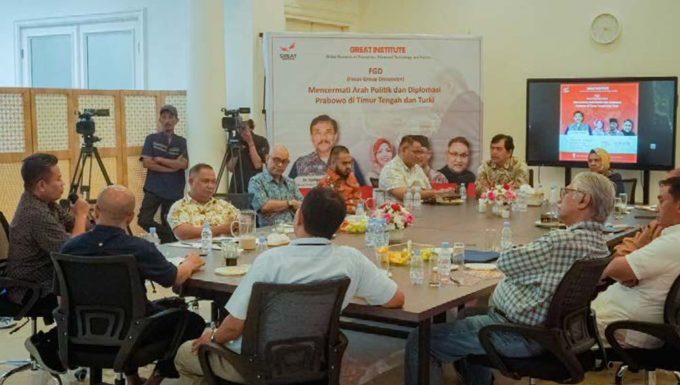
• Theme of the event: Agrarian Reform in the Context of Urban and Rural Areas: Inequality, Customary Rights, Spatial Planning, and the Agrarian Reform Implementation Agency
• Day and Date: Wednesday, October 1, 2025
• Time: 12.00 to 16.30
• Venue: GREAT Institute Office, Jl. Taman Gunawarman Timur No. 15, Selong, Kebayoran Baru, South Jakarta City, Special Capital Region of Jakarta
Moh Jumhur Hidayat, Chairman of the Advisory Council of GREAT Institute
Hanief Adrian, S.T., M.I.P., Researcher of GREAT Institute
• Radityo Egi Pratama, S.T. (Regent of South Lampung)
• Ahmad Irawan, S.H., M.H. (Member of the Indonesian Parliament, Commission II)
• Dr. Yagus Suyadi, S.H., M.Si. (Head of Land Acquisition Division I, Land Bank Agency)
• Rudi Rubijaya, S.P., M.Sc., Director of Land Reform, Ministry of ATR/BPN
• Dr. Agung Indrajit, ST, M.Sc., Deputy for Green and Digital Transformation, Nusantara Capital Authority (IKN)
• Prof. Dr. Ir. Budi Mulyanto, MSc, Professor of Soil Science, Faculty of Agriculture, IPB University
• Dr. Lilis Mulyani, SH, M.PIL, Senior Researcher, BRIN
• Dewi Kartika, Secretary General of the Agrarian Reform Consortium (KPA)
• Arwin Lubis, Land Activist ’80 ITB
• Ir. Hendry Harmen, MT, GREAT Institute
The agrarian reform FGD discussion highlighted various fundamental issues related to land ownership and distribution in Indonesia, as well as seeking alternative institutional and policy solutions. From the outset, speakers emphasized that although agrarian reform has long been introduced through the UUPA 1960, its implementation is still far from expectations. Moh Jumhur Hidayat (Chairman of the Advisory Council of GREAT Institute) emphasized land ownership inequality with a Gini ratio reaching 0.78, as well as the need for a populist agrarian reform model that favors land cultivators rather than a purely state-controlled model like communist systems.
Ahmad Irawan (Member of Parliament, Commission II) deepened the issue by highlighting that 60% of land is controlled by the Ministry of Forestry, which has resulted in the illegal status of thousands of villages that have long been settled in those areas. He stressed the need for a strong special institution, such as the Agrarian Reform Implementation Agency (BPRA), to resolve overlapping sectoral regulations and provide legal certainty.
From an institutional perspective, Dr. Yagus Suryadi explained the role of the Land Bank Agency, including the land bank concept aimed at economic justice, although its implementation must not be profit-oriented. This was reinforced by Rudi Rubijaya (Director of Land Reform, Ministry of ATR/BPN), who highlighted the importance of cross-sector policy coordination through a one map policy and the establishment of BPRA to systematically resolve agrarian conflicts.
Several speakers noted that agrarian reform is not only about land but also about other resources such as sea and air. Prof. Budi Mulyanto (IPB University) and Dr. Agung Indrajit (Deputy for Green and Digital Transformation, IKN Authority) emphasized the need for spatial planning based on clear and integrated information, including the use of digital solutions to minimize land conflicts.
Meanwhile, Dr. Lilis Mulyani (Senior Researcher, BRIN) highlighted the historical dynamics of agrarian reform from the 1960s to the present, which often shifts according to political interests. She argued that agrarian reform practices tend to become business as usual, focusing on identifying objects rather than resolving structural conflicts. Strong criticism also came from Dewi Kartika (Secretary General of KPA), who emphasized the danger of treating land purely as an economic commodity. She stressed that land has a social function, and therefore agrarian reform must focus on justice, food sovereignty, poverty alleviation, and rural empowerment.
The urban perspective was explained by Ir. Hendry Harmen (GREAT Institute), who highlighted the housing crisis, land speculation, and spatial planning that favors developers. He proposed a new paradigm of vertical housing, optimization of state land, and inclusive financing to make urban agrarian reform more equitable. A historical view was also provided by Arwin Lubis (ITB Land Activist ’80), who reminded that agrarian inequality has increased since the colonial era, and that the fundamental principles of the 1960 UUPA state that the state must not treat land as a commodity.
Overall, the discussion underlined several key ideas:
• Agrarian reform must return to its original purpose, namely reducing inequality, providing legal certainty, resolving agrarian conflicts, and improving public welfare.
• Strong institutions, especially the establishment of BPRA, are needed to integrate policies and resolve overlapping sectoral regulations.
• Customary rights of indigenous communities must be strengthened, as many customary territories remain legally marginalized.
• Agrarian reform cannot focus only on rural areas but must also include urban issues such as housing, spatial planning, and land speculation.
• The orientation of agrarian reform must move away from land liberalization and purely investment-driven logic, reaffirming the social function of land as mandated by the constitution.
Based on the results of the Focus GREAT Discussion titled “Agrarian Reform in the Context of Urban and Rural Areas: Inequality, Customary Rights, Spatial Planning, and the Agrarian Reform Implementation Agency,” conducted by representatives of government, academia, practitioners, and agrarian activists, the following Panca Prakarsa Agraria policy recommendations were produced:
• All agrarian regulations (land, water, air, and natural resources) must be based on Article 33 paragraphs 1, 2, and 3 of the 1945 Constitution and the 1960 Basic Agrarian Law (UUPA).
• The Agrarian Reform Implementation Agency must be led directly by the President as Chair of the Agrarian Reform Steering Council and headed by an ideologically committed figure on agrarian issues.
• Agrarian resources, in addition to their economic function, must have a social function protected by the state.
• The Agrarian Reform Implementation Agency should have a “Deputy for Firm Interpretation” to resolve differences in interpretation between state institutions regarding land use and agrarian resources.
• Land use and agrarian resource utilization must be based on a single national mapping system that takes into account individual rights and customary rights in land ownership.
The Focus GREAT Discussion on “Agrarian Reform in the Context of Urban and Rural Areas: Inequality, Customary Rights, Spatial Planning, and the Agrarian Reform Implementation Agency” has examined agrarian problems and reform efforts in Indonesia. The high level of land inequality, housing backlog and urban land supply issues, and difficulties in resolving agrarian conflicts are urgent problems that must be addressed.
Agrarian reform remains a key option for restructuring land governance in Indonesia. However, over the past decade, its implementation still requires evaluation. Currently, President Prabowo Subianto plans to implement agrarian reform programs to achieve food self-sufficiency. Therefore, as an evaluation of previous agrarian reform programs, it is necessary to establish an Agrarian Reform Implementation Agency (BPRA) as a super-body institution directly responsible to the President to implement these programs.