

By: Perdana Wahyu Santosa*
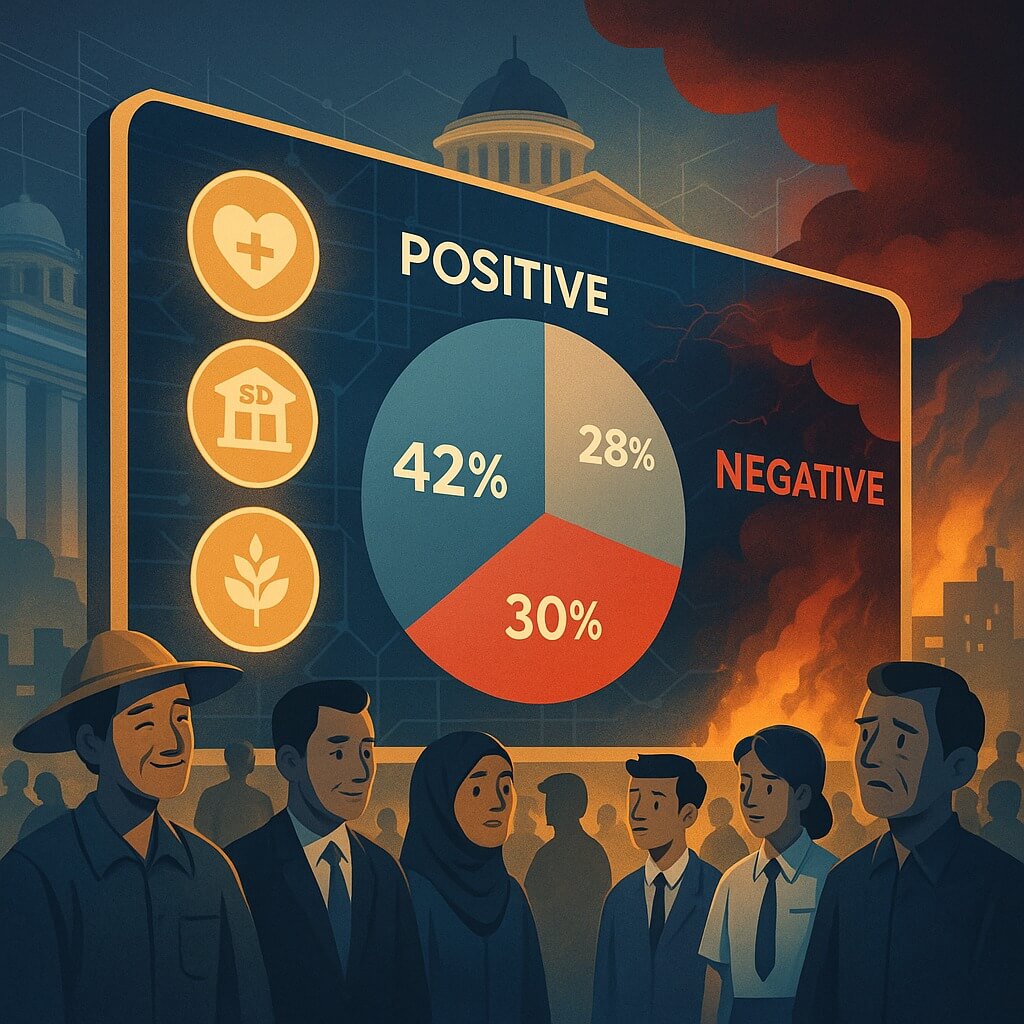
JERNIH– The results of social media sentiment monitoring during the first year of President Prabowo Subianto’s administration, based on more than 804 thousand posts analyzed by Kompas, provide an interesting picture of the dynamics of public perception toward the direction of national policy. Overall, 42% of public sentiment is positive, followed by 28% neutral, and 30% negative. This proportion illustrates that the level of public appreciation for government performance is still higher than criticism, indicating space for optimism and acceptance of the change agenda.
Furthermore, sentiment toward priority government programs shows strong support for programs that address basic needs. Free health check services received 80% positive sentiment, followed by the “Sekolah Rakyat” program (76%), food self-sufficiency (72%), and downstreaming and industrialization (70%). These programs appear to be considered relevant to public needs, especially amid global economic pressure, rising food prices, and uncertainty in the labor market.
Interestingly, there is a significant contrast in the issue of corruption eradication, where negative sentiment (39%) is slightly higher than positive sentiment (38%). This indicates that the public places high expectations on consistency and firmness in the anti-corruption agenda. In the digital era, public trust is very sensitive to issues of integrity, so even small deviations in policy or political events can immediately trigger critical public responses.
This digital sentiment monitoring shows that society is becoming more rational in giving assessments: providing appreciation for programs that deliver direct benefits, but remaining critical of governance aspects. This pattern is healthy for democracy, because it creates a space for dialogue between society and the government, while also serving as an early indicator for the direction of future public policy improvements.
-Government Constraints. Although survey results show positive sentiment outweighing negative sentiment, there are several fundamental constraints that need to be read as early warnings for the government.
-Policy Consistency and Implementation Capacity Challenges. Large programs such as free health checks, free nutritious meals (MBG), and food self-sufficiency require cross-ministerial consolidation, local governments, and public service networks. In many cases, public acceptance is high but implementation capacity remains uneven. This gap can become a source of public disappointment if not properly anticipated.
-Public Perception Sensitive to Government Integrity. The dominance of negative sentiment on corruption eradication issues shows that governance problems remain the main concern of the public. The lack of significant breakthroughs in law enforcement, perceptions of political elitism, and several institutional dynamics may worsen public trust levels if not addressed through concrete steps.
Suboptimal Public Communication. In the midst of a rapid flow of information, poorly delivered policy communication has the potential to create negative perceptions, even though the program actually provides benefits. Misalignment of communication between central and regional governments and among ministries often creates public confusion and opens space for misinformation.
Macroeconomic Challenges and Political Distractions. Rising food prices, global turbulence, and domestic political dynamics also shape public perception. If external disturbances are not managed with appropriate narratives and policies, public sentiment can quickly reverse. Data shows that negative sentiment increases on issues related to political stability and security, indicating public sensitivity to uncertainty.
Strategic Recommendations
Looking at the sentiment map and these challenges, there are several strategic steps that can strengthen government effectiveness while also building public trust.
Strengthening Transparency and Public Communication. The government needs to communicate program achievements using a data-based approach and narratives that are easier to understand. Good communication is not only about informing, but also educating. Digital channels need to be optimized to clarify the progress, challenges, and impacts of priority programs so that the public feels involved in the development process.
Making Governance Reform the Main Agenda. When corruption is the most sensitive issue for the public, reform steps must be strengthened: digitalization of public services, improving supervision of state and regional budgets (APBN/APBD), promoting integrity among public officials, and strengthening coordination among law enforcement institutions. These efforts need to be carried out consistently and communicated openly to the public to increase trust.
Accelerating Deliverables of Highly Supported Programs. Programs such as free healthcare, food self-sufficiency, MBG, village cooperatives, and “Sekolah Rakyat” have strong public legitimacy. The government can use these programs as showcases of fast, measurable, and broad-impact success. Accelerating popular programs can create a trust multiplier effect for other more technical and long-term policies.
Developing a Digital Feedback Mechanism. Digital sentiment can function as an early diagnostic tool. The government can build a real-time public opinion monitoring dashboard that helps ministers, local governments, and related institutions respond to issues more quickly and accurately. Fast response is not only a communication strategy, but also part of adaptive governance in the digital era.
Strengthening Central–Regional Synergy. The success of priority programs heavily depends on regional implementation. The government needs to strengthen technical assistance, digitalization of regional administration, and more standardized monitoring mechanisms to ensure public services are delivered evenly and with quality.
Conclusion
The latest Kompas survey results show that public sentiment over the past year indicates that Indonesians assess the government objectively—appreciating policies with concrete benefits, while remaining critical of integrity and governance quality. The positive sentiment capital emerging in many priority programs is an important political and social asset for the government to strengthen legitimacy and accelerate the development agenda.
With improvements in public communication, policy consistency, and the courage to strengthen governance, the government can transform this still “soft” public optimism into more mature confidence. Ultimately, the generally positive direction of public perception is an important foundation for more inclusive, sustainable national development that is oriented toward public welfare.
Public sentiment is not the end, but a strategic direction of governance, where first-year indicators show that the direction of change remains wide open, provided that policy navigation is carried out with integrity, firmness, and clarity of vision. [ ]
- Professor of Economics, Dean of FEB Universitas YARSI, Director of Research at GREAT Institute, and CEO of SAN Scientific