
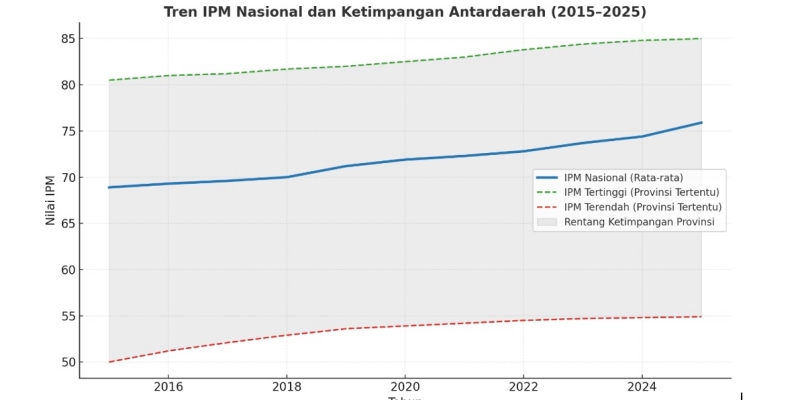

BPS Report on the increase in the national HDI in 2025 to 75.90 is often interpreted as evidence of socio-economic progress. However, the national average may conceal spatial and sectoral heterogeneity.
In 2025, the HDI range across provinces remains very wide: 54.91 (Highland Papua) to 85.05 (DKI Jakarta). There has been some mobility in status, where the Riau Islands have entered the “very high” category (80.53) and Southwest Papua has risen to “high” (70.55), yet the map of inequality has not shifted drastically: 3 provinces are “very high”, 30 are “high”, 4 are “medium”, and 1 is “low”.
At the same time, the components of HDI—life expectancy (UHH): 74.47; expected years of schooling (HLS): 13.30; mean years of schooling (RLS): 9.07; and real expenditure of IDR 12.802 million—all increased compared to 2024.
However, this improvement unfortunately does not automatically eliminate labor market duality: the modern sector (advanced manufacturing, corporate services, finance, premium tourism) offers higher wages and formal benefits, while the traditional/informal sector remains labor-intensive, low-productivity, and with limited social protection.
Lewis Dual-Sector and Efficiency Wage
The Lewis Dual-Sector model explains the development transition from a traditional sector (labor surplus, marginal productivity close to zero) to a modern sector (capital-intensive, high productivity). In the early phase, rural-to-urban labor migration increases modern sector output without significantly raising rural wages.
The transition is successful if and only if the rate of modern sector expansion continuously absorbs labor surplus.
The problem is that if investment in the modern sector begins to slow (high logistics costs, expensive electricity supply, licensing barriers, weak industrial agglomeration, and extortion activities), then a “dualism trap” occurs: labor surplus is not fully absorbed and becomes concentrated in urban informality.
At this point, the intuition of Efficiency Wage also applies, meaning modern firms often pay wages above the market level to reduce turnover and increase effort, thereby widening the wage-productivity gap compared to MSMEs.
Without bridging policies, this gap will persist even though HDI—which reflects “basic capabilities”—continues to rise.
It also appears necessary to recognize that HLS/RLS indicators reflect quantity of education, not learning quality. If quality stagnates, “years of schooling” become a weak signal of productivity.
Therefore, labor policy must be based on learning outcomes (literacy, numeracy, problem-solving), not merely years of schooling.
How to Bridge Dualism?
Planned agglomeration outside Java. Form growth nodes that integrate vocational education, job training centers, and region-specific industrial clusters. For example: food processing and cold-chain in Sulawesi; technology-based fisheries and ship maintenance in Maluku; logistics-energy and supporting manufacturing in Kalimantan.
The goal is to transform increases in HLS/RLS into local value-added job absorption so that migration is reduced.
Supply chain partnership (vendor upgrading). Design fiscal incentives for anchor companies to onboard local MSMEs into formal supply chains (quality standardization, lean manufacturing, bookkeeping digitalization). Learning-by-supplying accelerates productivity diffusion and reduces wage gaps.
Portable benefits schemes for informal workers. Many workers are absorbed in non-standard sectors. Portable social protection packages—health insurance, micro accident insurance, light pension contributions—will improve effective wellbeing and reduce poverty vulnerability even under flexible employment relationships.
Labor market information and mobility. Develop inter-regional job matching with machine-readable competency standards (digital portfolios, micro-credential badges).
Provide relocation/housing subsidies for workers who sign formal contracts across provinces—particularly relevant when HDI gaps between regions remain wide (85.05 vs 54.91).
Learning quality as regional KPI. Set targets for improvements in literacy and numeracy and adaptive technology-based assessments. Provide performance grants to regions that demonstrate measurable improvements in learning outcomes, not merely increases in HLS/RLS numbers.
Work-based learning and certification standardization. Expand paid apprenticeships with national occupational standards (e.g., CNC operator, PV technician, certified welder) and accelerated recognition pathways so that experienced informal workers can “upgrade” into the modern sector.
With these policy packages, the increase in average HDI can more easily be translated into a more distributed structural transformation, so that it does not only benefit islands of progress in a few agglomerations.
Conclusion
The rise of HDI to 75.90 indicates that basic human capacities such as health, education, and purchasing power continue to strengthen. However, the national average masks spatial and sectoral gaps—some regions and sectors are still progressing slowly, while modern clusters advance rapidly. This is a signal of progress that deserves appreciation as well as an unfinished equity challenge.
Through the Lewis Dual-Sector perspective and the intuition of efficiency wage, we see why dualism persists: absorption in the modern sector is not yet wide enough, coordination and logistics costs remain high, and learning quality has not been sustained.
Years of schooling are increasing, but have not fully translated into measurable learning outcomes, and “years of schooling” can become a weak signal in the labor market.
The proposed solutions—such as planned agglomeration outside Java, MSME vendor upgrading in supply chains, portable benefits for non-standard workers, competency-based job matching with relocation subsidies, and apprenticeship standardization—aim to turn HDI from a number into productivity that is felt in reality. The key lies not only in cross-institutional orchestration but also in disciplined evidence-based evaluation.
In conclusion, an increase in HDI is only an initial foundation, not the finish line. Without building bridges to the production structure and learning quality, dualism will persist.
With consistent and measurable policy packages from the government, HDI growth can be translated into improved real wages, more equal career mobility, and inclusive and sustainable structural transformation.
Professor of Economics, Dean of the Faculty of Economics and Business, YARSI University, Research Director of GREAT Institute, and CEO of SAN Scientific