

By: Perdana Wahyu Santosa*
JERNIH – Over the past two decades, Indonesia has undertaken a long journey to reduce poverty, with various approaches that reflect changes in philosophy and national political economy dynamics. From the Direct Cash Assistance (BLT) era under President Susilo Bambang Yudhoyono (SBY), to the Indonesia Smart Card (KIP) and Family Hope Program (PKH) under Joko Widodo (Jokowi), and now the Free Nutritious Meals (MBG) program and Red-and-White Village Cooperatives under President Prabowo Subianto — each policy reflects a different way of understanding poverty in its respective era.
Yet the question remains the same: how effective are these strategies in addressing the root causes of social inequality, especially in the digital era?
Post-Crisis Social Consolidation Phase
During the crucial 2004–2014 period, the SBY administration led Indonesia out of the 1998 economic crisis trauma toward relatively strong macroeconomic stability. Statistics Indonesia (BPS) recorded a decline in the poverty rate from 16.66 percent in 2004 to 10.96 percent in 2014 — an average decrease of 0.57 percentage points per year. This success was driven not only by economic growth, but also by social policy innovations such as BLT and the National Community Empowerment Program (PNPM Mandiri).
These policies played a key role in stabilizing poor households’ consumption during global oil price shocks in 2005 and 2008. BLT served as an effective social safety net in protecting purchasing power from inflation shocks. However, the model remained charity-based — it had not yet fully addressed productive economic empowerment. The poor were still passive recipients, not active participants.
Nevertheless, the SBY era marked an important turning point: social policy became part of national fiscal strategy, not merely a charitable project. This approach laid the foundation for a more systematic social protection system in later years.
The Era of Digitalization of Social Assistance
During the Jokowi administration (2014–2024), the paradigm shifted from emergency assistance toward a social inclusion economy. The poverty rate continued to decline from 11.22 percent in 2015 to around 9.03 percent in 2024. Although the pace slowed — about 0.27 percentage points per year — the global context was far more challenging, including the COVID-19 pandemic, energy crises, and supply chain disruptions.
The main strength of this administration was the integration of social policy with digital infrastructure. Programs such as the Indonesia Smart Card (KIP), Indonesia Health Card (KIS), and Non-Cash Food Assistance (BPNT) became pioneers of digitalization-based social assistance using integrated registry data. The Unified Social Welfare Data (DTKS) became the foundation for evidence-based targeting.
However, a paradox emerged. While digitalization improved distribution efficiency, issues of data accuracy and exclusion persisted. Many newly poor households after the pandemic were not registered, while some recipients remained from older categories. This classic inclusion–exclusion error highlights the need for deeper integration between fiscal, demographic, and socio-economic data systems.
In addition, social policy increasingly focused on human capital development. The emphasis shifted from cash transfers to expanding access to education and health services. At the macro level, this improved outcomes: the Human Development Index (HDI) rose from 72.81 (2020) to 75.02 (2024). However, this improvement did not fully reduce income inequality, especially across regions and social groups.
The Era of MBG and Village Cooperatives
When President Prabowo Subianto took office in October 2024, the socio-economic landscape had changed significantly. The challenge is no longer merely reducing the number of poor people, but strengthening household economic resilience against increasingly intense global shocks. In this context, the Free Nutritious Meals (MBG) program represents a new concept by integrating health, education, and food sovereignty into a single inclusive policy.
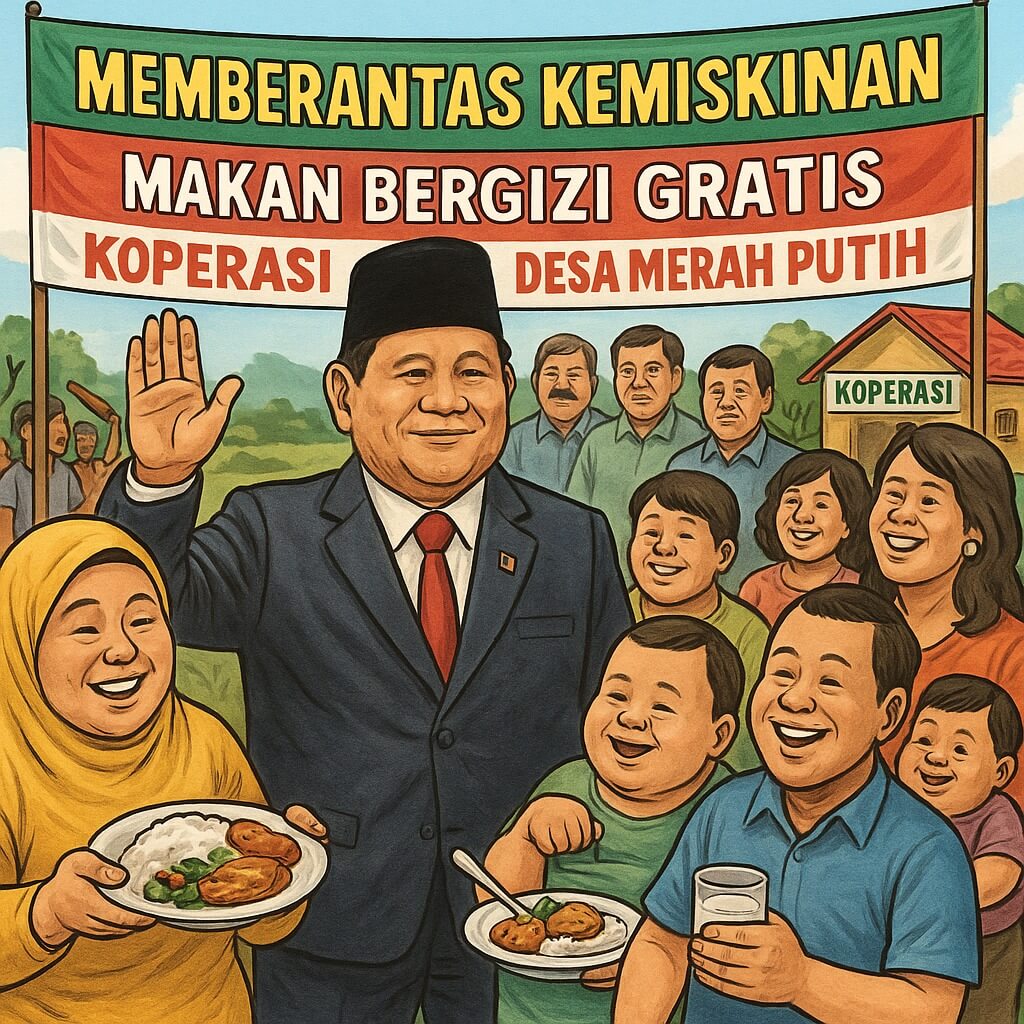
The MBG program targets tens of millions of students across Indonesia by providing free nutritious meals every school day. Economically, this policy has multiplier potential: strengthening demand for local food supply chains, creating jobs in the food sector, and improving learning productivity. If well managed, MBG could become a long-term poverty alleviation instrument that not only provides assistance but also builds generational resilience.
Alongside this, the Red-and-White Village Cooperative program serves as a grassroots economic engine. By July 2025, 80,081 new cooperatives had been established across 38 provinces. This approach revives the spirit of cooperatives as a pillar of the solidarity economy, supported by centralized financing and training. It marks a paradigm shift from consumption-based social policy to production-oriented empowerment.
Effectiveness Challenges
Although various social policies have successfully reduced the poverty rate to its lowest level (8.47 percent in 2025), the next challenge lies in effectiveness and sustainability. In the digital era, poverty alleviation cannot only be measured through cash transfers or food assistance, but also through digital inclusion. Many of the poor today are not physically poor, but digitally excluded — lacking internet access, digital literacy, or access to new technology-driven economic opportunities.
Therefore, future social policy must evolve toward a Digital Poverty Alleviation System — an integrated big data-based system capable of detecting, targeting, and monitoring poor households in real time. Integration of BPS, Ministry of Social Affairs, BPJS, and fintech data platforms could build a more precise and adaptive social policy architecture.
Conclusion
Indonesia’s 20-year poverty alleviation journey shows a clear pattern: the state is increasingly learning to integrate economic and social policies in a more systematic way. The SBY era laid the foundation, the Jokowi era expanded it through digitalization, and the Prabowo era seeks to combine nutrition, education, and village empowerment.
However, policy effectiveness is not determined solely by budget size, but by governance and the ability to transform society from recipients into active economic actors. In the Prabowo era, poverty alleviation must be seen not as a fiscal burden, but as a social investment that builds national productivity.
If social policy can bridge the gap between assistance and empowerment, Indonesia will not only reduce poverty figures but also build a resilient, productive, and competitive middle-class society — this is the true meaning of social justice in the digital era.
- Professor of Economics, Dean of the Faculty of Economics and Business, YARSI University, and Director of Research, GREAT Institute