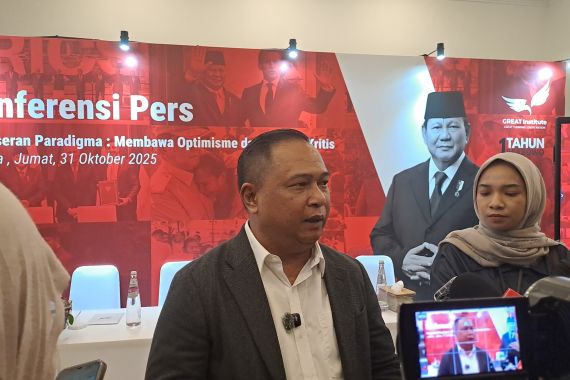



Indonesia’s economy grew by 5.61 percent year-on-year in the first quarter of 2026, improving from 5.39 percent in the fourth quarter of 2025 and 4.87 percent in the first quarter of 2025. The achievement marked the strongest first-quarter economic growth in more than a decade and reflected the resilience of the national economy amid ongoing global challenges.
According to Yossi Martino, Economic Researcher at GREAT Institute, this performance was closely linked to the government’s successful implementation of a frontloading strategy, which accelerated state spending at the beginning of the year. The policy helped inject liquidity into the economy early and provided additional momentum for growth during a period of heightened global uncertainty.
The Role of Government Spending in Economic Growth
Statistics Indonesia (BPS) data showed that government consumption recorded the highest growth among expenditure components, expanding by 21.81 percent. Household consumption grew by 5.52 percent, while Gross Fixed Capital Formation (GFCF) increased by 5.96 percent. Together, household consumption and investment accounted for more than 80 percent of Indonesia’s Gross Domestic Product (GDP).
According to Yossi, these figures demonstrate that the frontloading strategy not only accelerated budget realization but also strengthened the transmission of fiscal policy into sectors closely linked to domestic demand and community economic activities.
From the production side, the accommodation and food service sector posted the highest growth at 13.14 percent. The strong performance reflected increased economic activity during the Ramadan and Eid al-Fitr period, which contributed positively to overall economic growth.
Maintaining Purchasing Power Amid Weakening Consumer Sentiment
GREAT Institute noted that the first-quarter growth performance was particularly significant because it occurred during a period of moderating consumer sentiment. Data from Bank Indonesia showed that the Consumer Confidence Index declined from 127 in January to 122.9 in March 2026, although it remained within optimistic territory.
Under these circumstances, the government was considered successful in maintaining household purchasing power through the acceleration of social assistance programs, the disbursement of holiday allowances (THR), and the implementation of various priority programs supporting domestic consumption. These measures helped sustain positive consumption growth despite pressure on consumer perceptions and expectations.
Balancing Economic Stimulus and Fiscal Discipline
State expenditure realization reached IDR 815 trillion by the end of March 2026, representing growth of 31.4 percent compared to the same period a year earlier. Central government expenditure amounted to IDR 610.3 trillion, growing by 47.7 percent, while non-ministerial and institutional spending increased by 51.5 percent to IDR 329.1 trillion. During the same period, the state budget deficit reached IDR 240.1 trillion, equivalent to approximately 0.93 percent of GDP.
According to GREAT Institute, this development was a natural consequence of accelerating government spending at the beginning of the fiscal year. Nevertheless, the government must continue to balance growth-supporting stimulus measures with fiscal sustainability and discipline.
The Next Agenda for Sustaining Growth Momentum
Looking ahead, GREAT Institute encourages the government to complement the frontloading strategy with broader supporting policies. Key priorities include accelerating investment incentives, strengthening downstream industrialization to reduce dependence on commodity price fluctuations, improving the governance of government priority programs, and enhancing the effectiveness of social protection measures to better support vulnerable groups and the middle class.
According to Yossi Martino, if the current growth momentum can be maintained consistently throughout 2026, the government’s economic growth target of 5.4–5.6 percent remains achievable. Such an outcome would further strengthen Indonesia’s economic resilience amid continuing geopolitical and global economic uncertainty.
Sources:
- Warta Ekonomi – GREAT Institute Appreciates the Success of Prabowo’s Economic Team: The Frontloading Strategy Has Proven Effective
- Investor.id – Frontloading Strategy Drives Economic Growth
- State Secretariat of the Republic of Indonesia – Indonesia’s Economy Grew by 5.61 Percent in the First Quarter of 2026