

Background
United States foreign policy in recent years has shown a significant shift in its pattern of leadership, causing a geopolitical shock in the governance of international relations—specifically regarding the role of the United States as a global superpower. The return of Donald Trump to power for his second term as President of the United States marks a new chapter in Washington’s foreign policy direction, which is becoming increasingly confrontational, unilateral, and oriented toward prioritizing American interests (America First). This approach demonstrates Washington’s inclination to no longer act as a guarantor of a free and peaceful global order’s stability under the perspective of democratic peace theory, but rather as a hegemonic actor that aggressively deploys its political, economic, and military power to impose its will on other nations.
Under Trump’s second-term leadership, the United States has exhibited an increasingly arrogant stance in international relations. Under the pretext of reviving the Monroe Doctrine—which he has modified into the “Donroe” (Donald-Monroe) Doctrine—the US utilizes a coercive approach to assert its hegemony in the Western Hemisphere. Beginning with unilateral actions against Venezuela, the US Military executed a naval blockade under the guise of combating drug trafficking, followed by an operation to abduct President Nicolás Maduro. This threat extended to Cuba, tightened control over the Panama Canal, and even reached the discourse of annexing the territory of Greenland from Denmark, which openly disregarded the principle of state sovereignty, although it eventually concluded through negotiations.
In Middle Eastern affairs, Trump unilaterally initiated the establishment of the Board of Peace (BoP) or Peace Council for the reconstruction of the Gaza Strip alongside Indonesia, Turkey, Egypt, Jordan, Pakistan, Qatar, Saudi Arabia, and the United States. This BoP was actually the brainchild of Jared Kushner, Trump’s son-in-law who also serves as a senior advisor to the President and maintains a very close relationship with PM Netanyahu of Israel. So close is the personal relationship between Trump and Netanyahu that the US Military, without a mandate from Congress, prepared troops under the USS Abraham Lincoln carrier strike group and the IDF (Israeli Defense Forces) to stand ready to invade Iran and its allies in the Middle East, such as Hezbollah in Lebanon and the Houthis in Yemen, whom they deem a threat to Israel.
Furthermore, United States relations with its traditional allies, namely Canada and the European Union—all of which, with the exception of the Republic of Ireland and Austria, are members of the North Atlantic Treaty Organization (NATO)—have experienced a significant decline due to Trump’s confrontational and pressuring stance. Trump uses trade tariff pressures as an instrument of foreign policy that exacerbates United States relations with many of its trading partners. Tariff policies are utilized not merely as a tool for domestic economic protection, but as a means of political leverage to force United States interests upon other countries. This strategy undermines the principles of free trade and multilateralism which, since the end of World War II and the inception of the Bretton Woods System, have served as the foundation of the global political-economic system.
Moreover, the Trump administration has once again withdrawn the United States from various international organizations and agreements, including multilateral forums that have long been pillars of global governance. This stance reinforces the impression that the United States is no longer committed to collective leadership, preferring instead a unilateral approach that prioritizes dominance and short-term interests. Consequently, the legitimacy of the international order, which has been unipolarly led by the United States, is increasingly eroding and steering toward a multipolar order.
The reaction from Western nations against Trump’s leadership has also become more visible. A number of Western leaders have openly demonstrated discomfort toward the direction of United States policy. One of the most striking examples is the statement by Canadian Prime Minister Mark Carney at the World Economic Forum in Davos, who asserted his country’s intention to strengthen cooperation with China and third-world nations, while acknowledging that the old world order led by the United States has ended. This statement reflects a crisis of confidence in United States leadership among its own allies.
In a broader global context, the weakening of United States leadership following the failure of Neoconservative politics to maintain world stability post-US invasions of Afghanistan and Iraq has opened up space for the rise and consolidation of other great powers, particularly China and Russia. China is becoming increasingly active in expanding its influence through economic, diplomatic, and military initiatives, while Russia seeks to reassert its position as a strategic power through aggressive security and geopolitical approaches. The rivalry among the United States, China, and Russia has now become the primary axis in the great powers struggle that is shaking the geopolitical landscape and reshaping the global power structure. Based on this geopolitical situation, Trump has openly returned to utilizing Neoconservative politics, namely maintaining US dominance as a global peacekeeper through hawkish means.
In an international context, the hawkish US foreign policy of the Trump era certainly opens up opportunities for the formation of a multipolar situation, and even a multiblock geopolitics where new blocks will form independent of the orbits of the US, Russia, China, and even the European Union. For instance, Turkey and Saudi Arabia have emerged as dominant powers in the Middle East due to their success in toppling the Bashar Al-Assad Regime by assisting the Hay’at Tahrir al-Sham guerrillas led by Mohammad Al-Jaulani or Ahmed Al-Sharaa. Iran was previously known as a small block supporting guerrilla organizations such as Hamas, Lebanon’s Hezbollah, the Yemeni Houthis, and other non-state actors.
Regarding the regional situation in Asia, countries like Japan and South Korea are increasing their defense budgets and strengthening their alliances as they face the threat of a Chinese invasion of Taiwan and the Sea of Japan. ASEAN countries are divided in responding to China’s business and military expansion, where Malaysia, Thailand, and Myanmar view China’s expansion as an opportunity, while Vietnam and the Philippines perceive it as a threat to sovereignty. Meanwhile, Indonesia remains neutral and tends to be ambivalent because China’s expansion does not directly threaten our country’s territory, except for China’s Nine-Dash Line territorial claim over the North Natuna Sea, which forms part of the South China Sea.
For Indonesia, this geopolitical turmoil carries crucial strategic implications. We maintain good relations with the Great Powers, namely the United States, China, the European Union, and even Russia, which serves as Indonesia’s partner in the economic sector. The global tensions triggered by the aggressive policies of the United States could affect trade stability, investment, as well as Indonesia’s diplomatic position. Furthermore, the rising Great Powers rivalry demands that Indonesia strengthen its diplomatic capacity, defense, and an independent foreign policy in order to remain capable of protecting national interests amidst global uncertainty.
Indonesia offered no resistance when facing trade policy pressures from the US and resolved it through negotiations under the Prabowo Administration, accepting a 19 percent trade tariff. Although in reality, these negotiations seek to balance the dominance of imported goods from China and raw material exports from Indonesia to the Land of the Red Dragon. During the meeting in Davos, President Prabowo, without hesitation upon Trump’s invitation, even co-signed the formation of the Board of Peace as one of its founders, and stands ready to contribute USD 1 Billion for the reconstruction of Gaza.
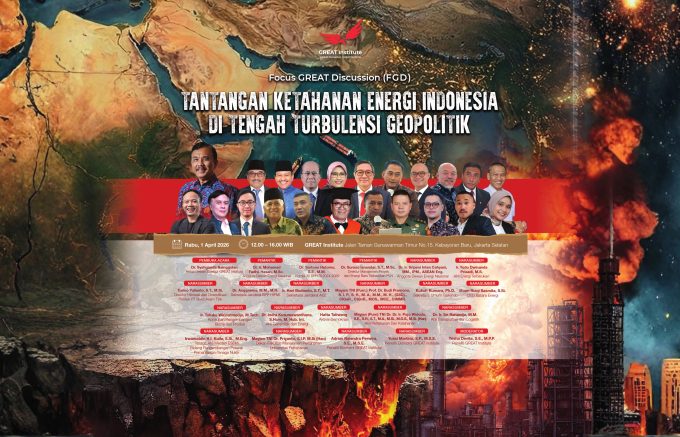
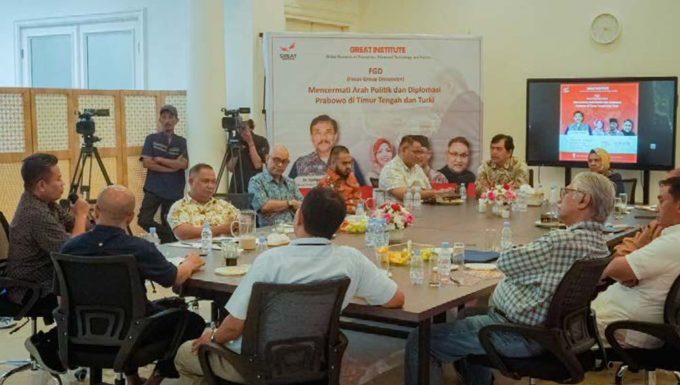
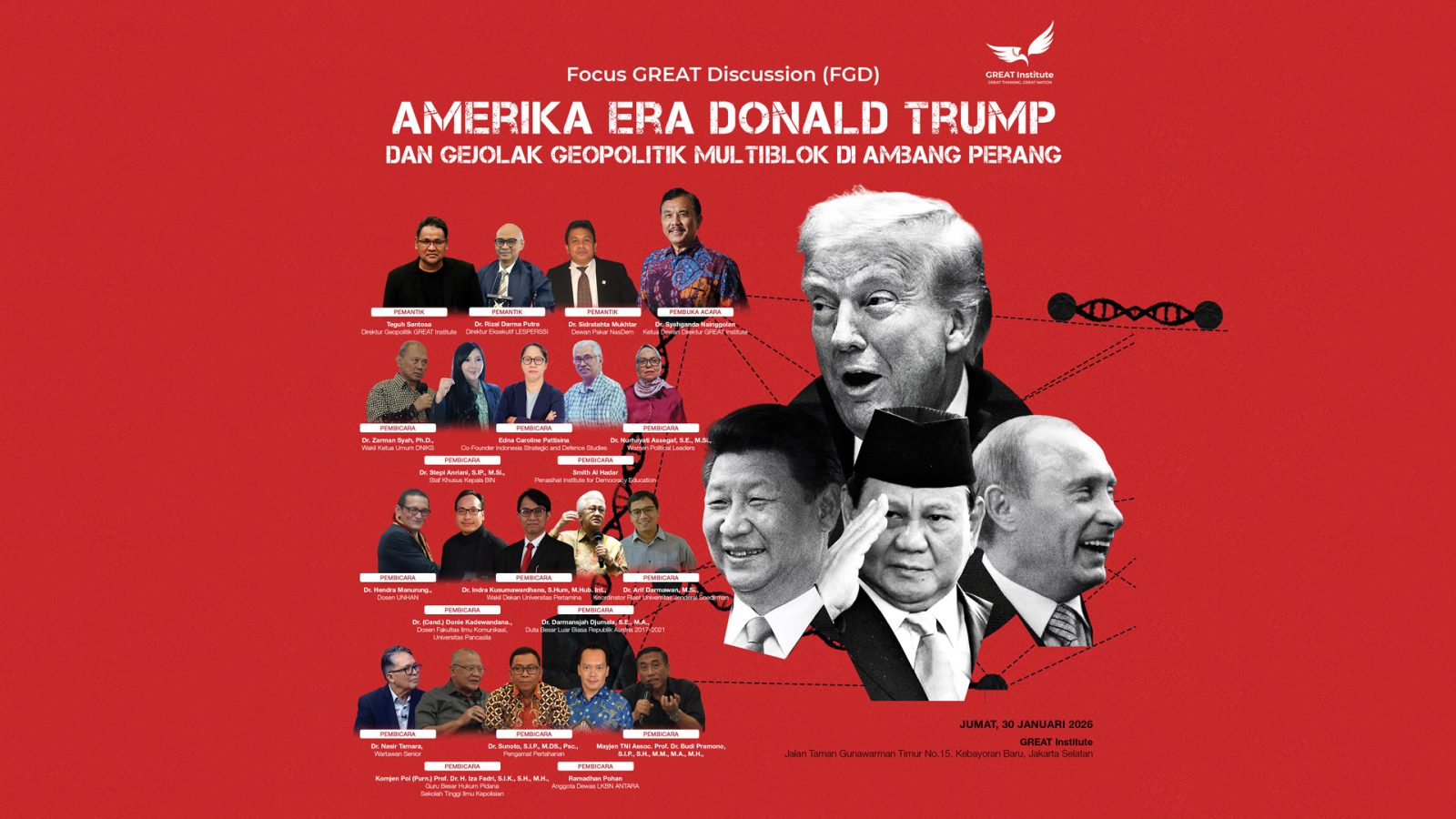
It is within this context that a comprehensive and strategic discussion space is required to deliberate on the direction of America’s foreign policy under Trump’s leadership, its impact on the geopolitical turmoil heading toward a multiblock structure, and its implications for Indonesia and Southeast Asia. Therefore, the GREAT Institute deems it necessary to organize a Focus Group Discussion (FGD) entitled “America in the Donald Trump Era and Geopolitical Turmoil on the Brink of a Multiblock War”.
B. Objectives, Scope, and Expected Outcomes of the Activity
This FGD aims to:
- Analyze the direction of United States foreign policy under Donald Trump’s second-term leadership and its impact on the global order.
- Examine the forms of United States foreign policy, including the use of tariffs, diplomatic pressure, and unilateral actions.
- Analyze the responses of traditional US allies as well as its geopolitical rivals to Trump’s leadership.
- Identify the impact of United States policies on great powers rivalry, specifically with China and Russia.
- Analyze the implications of the geopolitical turmoil resulting from Donald Trump’s foreign policy on Southeast Asia and Indonesia’s strategic role in the Gaza Board of Peace.