


Reflection on National Awakening Day and Reform, May 20 always reminds us that this nation was not born out of comfort, but out of the pressures of its era.
The National Awakening of 1908 emerged when the indigenous people realized that colonialism could not be fought with fear and division. From the small rooms of STOVIA, the courage to think as a nation was born. From Boedi Oetomo grew the awareness that Indonesia could only stand if its people believed in their own future.
Decades later, the Reform era of 1998 was also born out of a major test. The economic crisis hit hard, the rupiah collapsed, banks failed, inflation surged, demonstrations escalated, and the country stood at the most critical point in its modern history.
I experienced that atmosphere firsthand. When prices soared uncontrollably, public trust collapsed, and uncertainty could be felt in every corner of life. At that time, Indonesia was not only facing an economic crisis, but also a crisis of legitimacy and a crisis of national direction.
That is why equating Indonesia’s current condition with 1998 is an oversimplification.
It is true that the world is not in a good state right now. The dollar is strengthening. The Federal Reserve’s interest rates remain high. Geopolitical conflicts are unresolved. Global trade is slowing down. Almost all developing countries are facing similar pressures. However, Indonesia today has a far different foundation compared to three decades ago.
Indonesia’s foreign exchange reserves as of April 2026 reached approximately USD 146.2 billion. Inflation remains relatively controlled at around 2.42 percent. Economic growth is still moving at around 5 percent. The banking system is stronger, fiscal oversight is more disciplined, and domestic consumption continues to serve as the main buffer of the national economy.
This is not a situation without problems. But neither is it a sign of a collapsing state.
What is truly being tested today is not only the rupiah, but our national mentality itself: whether this nation panics easily whenever facing global pressure, or instead is capable of turning crises into momentum for moving to the next level.
In that context, optimism is not merely political rhetoric. Optimism is part of state strategy.
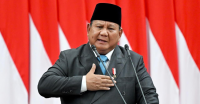
Prabowo Subianto has repeatedly emphasized that Indonesia must not become a nation that is easily frightened by global turbulence. Confidence is necessary so that society does not fall into pessimism, which would only weaken the national economy further. In the modern economy, public psychology is often just as important as statistical figures. Panic can create crises that could actually have been avoided.
National Awakening Day should serve as a reminder that Indonesia’s greatest strength has always come from believing in itself.
This nation is too large to continue living in fear. We possess natural resources, a demographic bonus, a large domestic market, and an increasingly strategic geopolitical position amid the shifting global economy. Our challenge now is not merely dealing with the fluctuations of the dollar, but building true national independence.
Reducing dependence on imports.
Strengthening national industries.
Encouraging downstream industrialization.
Expanding local currency transactions.
And ensuring that Indonesia’s wealth generates the greatest possible added value for its own people.
National awakening in the 21st century can no longer simply be understood as a struggle against physical colonialism. Today’s awakening is a nation’s ability to stand tall amid global pressure without losing confidence as a great country.
Because a great nation is not one that is never tested.
A great nation is one that remains calm when the world is shaking.
Indonesia is not collapsing.
Indonesia is being tested to move to the next level.